
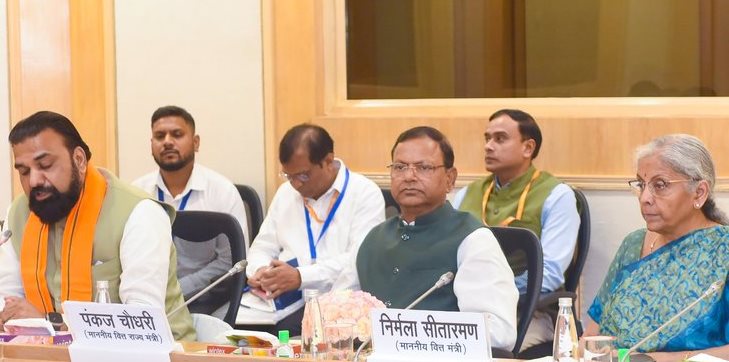
Finance Minister Nirmala Sitharaman chairs a meet of group of ministers(GoM) on GST rationilsation on Wednesday
Bihar Deputy Chief Minister Samrat Choudhary said the Group of Ministers (GoM) on Goods and Services Tax (GST) will propose exempting health and life insurance premiums from the levy
Almost all states were in favour of the proposal, but they asked the GST Council to device a mechanism by which the GST rate cut benefits are passed on to the customer, said Telangana Deputy Chief Minister Mallu Bhatti Vikramarka, a member of the GoM
New Delhi: In a cheering development for customers and insurers, the government has proposed completely exempting life and health insurance premium from Goods and Services Tax (GST), Bihar Deputy Chief Minister and convenor of insurance GoM Samrat Choudhary said on Wednesday.
Currently, health and life insurance premium attracts 18 per cent GST.
The GoM on life and health insurance will submit its report to the GST Council. The report will also include views and concerns expressed by some state finance ministers, he said.
“The Centre’s proposal is clear that the insurance sector’s individual and family (policies) should be exempt from GST. This has been discussed and the GoM report will be presented to the Council,” Choudhary told reporters here after the meeting of the GoM.
“All members have given their approval for lowering rates. Some states have given their own views,” he said, adding a final call on rates will be taken by the Council.
The 13-member state Group of Ministers on insurance held a meeting on Wednesday.
Almost all states were in favour of the proposal, but they asked the GST Council to device a mechanism by which the GST rate cut benefits are passed on to the customer, said Telangana Deputy Chief Minister Mallu Bhatti Vikramarka, a member of the GoM.
“We made it clear that the GST reduction benefit should go to policyholders and not companies, some mechanism has to be developed.”
“States wanted it (tax rate) to be brought down or exempt. At the same time many states told the (GoM) meeting that some mechanism must be developed so that rate cut benefit reaches the people. The GST Council will decide a mechanism,” Vikramarka said.
About Rs 9,700 crore annual revenue loss is estimated on account of GST exemption to individual insurance policies, he said.
The GoM will submit its report to the GST Council. The report will also include views and concerns expressed by some state finance ministers, Choudhary said.
“All members have given their approval for lowering rates. Some states have given their own views,” he said, adding a final call on rates will be taken by the Council.
The Centre’s proposal on insurance is part of the overall next-Gen GST reform proposal under which goods and services tax will be levied at 2 rates– 5 and 18 per cent — based on categorisation of products as merit and standard.
The GoM on health and life insurance was set up in September to suggest tax rates.
The GST Council, which includes representatives from the Centre and all states, is expected to take up the proposals next month.
Choudhary is the convenor of the 13-member state GoM on health and life insurance.
The 13-member GoM on health and life insurance was set up in September to suggest tax rates.
The panel, which includes ministers from Uttar Pradesh, Rajasthan, West Bengal, Karnataka, Kerala, Andhra Pradesh, Goa, Gujarat, Meghalaya, Punjab, Tamil Nadu and Telangana, has been mandated to submit its report to the GST Council by October end.
In 2023-24, the Centre and states collected Rs 8,262.94 crore through GST on health insurance premium, while Rs 1,484.36 crore was collected on account of GST on health reinsurance premium.
Meanwhile, Finance Minister Nirmala Sitharaman on Wednesday presented to GoMs(group of ministers) from states her government’s plans for sweeping reforms in the GST regime that involves slashing tax rates and easing compliance burden for businesses.
The finance minister’s address to the GoMs was for about 20 minutes during which she elaborated on the Centre’s proposal, a source said. She explained the necessity for GST reforms to the states, the source added.
The GoMs on rate rationalisation, insurance taxation and compensation cess will over two days deliberate on the Centre’s ‘next-gen’ GST reforms under which tax will be levied at 5 and 18 per cent rates.
A special 40 per cent rate has been proposed on 5-7 items, including sin goods.
GST is currently levied at 5, 12, 18 and 28 per cent. While food and essential items are either at nil or 5 per cent rate, luxury and demerit goods are in 28 per cent slab, with a cess on top of it.
The GoM on compensation cess was set up to decide on the future of compensation cess post the loan repayment period.
Besides, the GoM on insurance was deliberating on reducing tax rates on health and life insurance premium.
The rate rationalisation GoM was mandated to suggest changes in slabs and rates and also remove duty inversion faced by certain sectors.
The GoM on GST rate rationalisation is scheduled to meet again on August 21.
As per an SBI Research report, the proposal, if implemented, could result in revenue loss of about Rs 85,000 crore a year. For the current fiscal, the loss to revenue is estimated at Rs 45,000 crore assuming the new tax rates are implemented from October 1.
The Centre’s proposal once approved by the GoMs will be placed before the GST Council, comprising ministers from Centre and all states, in its meeting next month.
Prime Minister Narendra Modi has announced rollout of the GST reforms by Diwali.
The SBI Research report estimated that the effective weighted average GST rate came down from 14.4 per cent at the time of inception to 11.6 per cent in September 2019. Given the current rationalisation of rates, the effective weighted average GST rate may be 9.5 per cent.