
In its safety recommendations, AAIB said operators of uncontrolled airfields should allow flying activities only when the prevailing MET (Meteorological) conditions are within the criteria laid down in the relevant regulations
New Delhi:Aircraft accident probe agency, the Aircraft Accident Investigation Bureau, on Saturday released the preliminary report on the plane crash that killed Maharashtra Deputy Chief Minister Ajit Pawar and four others at Baramati on January 28 and said the visibility at the time of the crash was below the required level.
The AAIB flagged about fading marks on the runway and presence of loose gravels on the runway surface at Baramati as it recommended the regulator DGCA to ensure that stakeholders’ maintain safety standards at uncontrolled airfields.
The 22-page report also mentioned that “Oh Sht… Oh Sht,” words were transmitted from the aircraft before it crash landed on the left side of the runway at the Baramati airport.
The report also comes against the backdrop of concerns being raised about the crash of the VSR Ventures-owned Learjet 45 aircraft (VT-SSK) on January 28.
AAIB, on Saturday, said the data from the Solid State Cockpit Voice Recorder (SSCVR) would be downloaded with the assistance of the US National Transport Safety Board (NTSB).
The CVR was damaged in the crash.
Ill-fated Learjet plane hit trees before crash landing
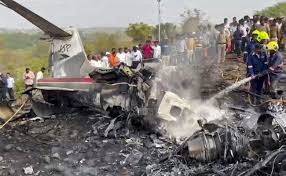
The ill-fated 15-year-old LearJet 45 XR aircraft banked towards the right, hit the trees and then the ground before going up in flames at the Baramati airport on January 28.
The Aircraft Accident Investigation Bureau’s preliminary report into the crash, that has also ignited concerns and political repercussions, also mentioned that the technician did not find any abnormality after post-flight checks on January 27 when the plane had returned to Mumbai after completing a flight.
Maharashtra Deputy Chief Minister Ajit Pawar and four others were killed in the crash of the aircraft that was flying from Mumbai to Baramati.
AAIB, citing CCTV footages installed in nearby village where the crash happened, said the aircraft was observed to have banked towards right before impacting the terrain.
“The aircraft first impacted the trees before hitting the ground which is at a lower elevation than the runway surface… the aircraft was engulfed in fire during which the entire cockpit and cabin section got burnt,” the 22-page preliminary report said.
On January 26, the VSR Ventures-owned aircraft VT-SSK had operated a charter flight for Mumbai-Surat-Mumbai sector.
This flight landed back at Mumbai late night at about 0020 hours on January 27.
“The operating crew of that flight stated that they did not find any abnormality in the aircraft during the entire flight and the flight on that day was uneventful.
The data downloaded from the Solid State Flight Data Recorder (SSFDR) is being analysed, the report said.
AAIB flags low visibility
On the day of the accident, AAIB said the tower was manned by a ground instructor of one of the FTO (Flying Training Organisation) who was communicating with the aircraft to assist the landing.
“The crew of VT-SSK asked for visibility while approaching Baramati for which the tower replied as 3,000 meters by looking at the visibility markers.
“Further, while giving the landing clearance, the tower informed winds as calm. Hence, the visibility reported at Baramati at the time of landing of aircraft was well below the minimum required for VFR flight which is 5,000 meters (5 km), ” the report said.
Further, AAIB said the last runway re-carpeting was carried out in March 2016 and thereafter no runway re-carpeting was carried out which resulted into fading of all the runway markings and presence of loose gravels on the runway surface.
“Records/information obtained from other stakeholders are currently being scrutinised… all the aspects of the accident will be examined and investigated to bring out the facts, root cause(s) and contributory factor(s) leading to the accident,” the report said.
AAIB’s safety recommendations
In its safety recommendations, AAIB said operators of uncontrolled airfields should allow flying activities only when the prevailing MET (Meteorological) conditions are within the criteria laid down in the relevant regulations.
The agency said the Directorate General of Civil Aviation (DGCA) may take necessary measures to enhance landing aids along with basic MET (Meteorological) facility at the uncontrolled airfields to cater for large number of Non-Scheduled/chartered flying operations, including VIP flights.
“It is recommended that DGCA may check the feasibility of licensing these aerodromes for conduct of safe and regulated flying operations,” AAIB said in the safety recommendations.
Another suggestion is for the DGCA to issue necessary directions to all operators operating VFR flights to uncontrolled airfields to strictly adhere to the laid-down standard operating procedures.
“It is recommended that DGCA may issue specific directions to all the stakeholders responsible for managing and maintain the uncontrolled airfields to ensure that the required safety standards are maintained at the airport for safe aircraft operations,” AAIB said and added that compliance can be checked during audits and surveillance.
Apart from the safety recommendations, AAIB, in a not-so-common practice, said that it may issue “safety recommendations at any stage of the investigation whenever it considers that necessary preventive measures are required to be taken promptly to enhance aviation safety”.