
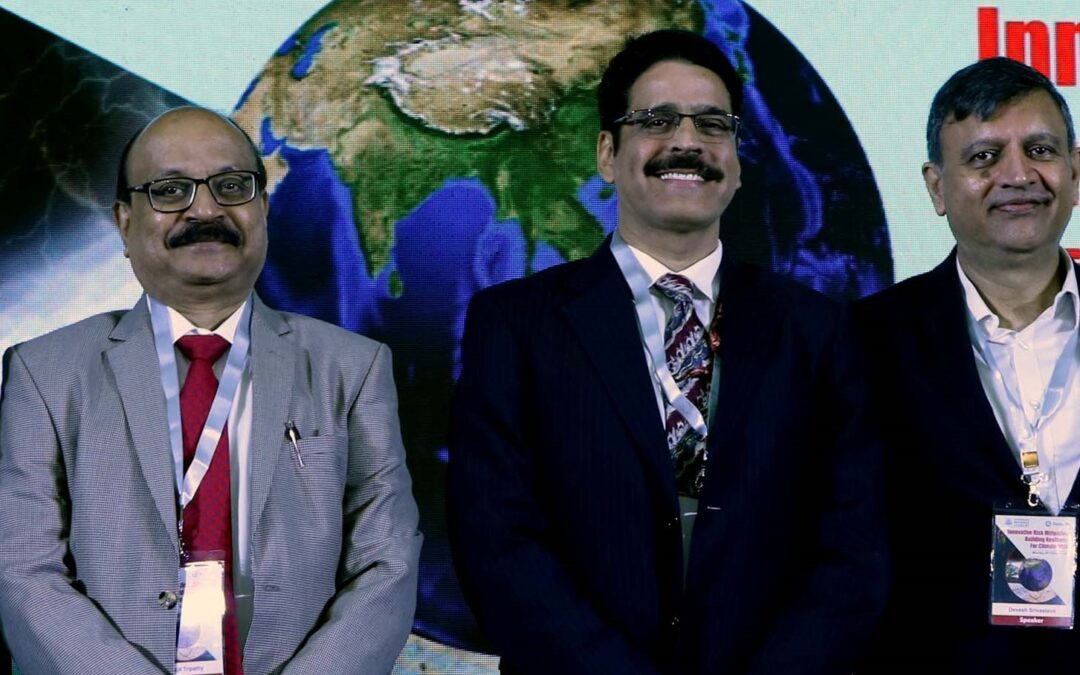
(Lto R) G. Srinivasan, Director of the National Insurance Academy,,Satyajit Tripathy, CMD, United India Insurance Company,Saurabh Mishra, Joint Secretary Department of financial services, Devesh Srivastava, CMD GIC Re,Hadi Riachi, CEO of Swiss Re India
Devesh Srivastava, CMD GIC Re said cyclones were once a regular occurrence along the eastern coastline of the country, but are now equally prevalent on the western coast, contributing to the Nat Cat losses that India may face
Hadi Riachi, CEO of Swiss Re India, said in the worst-case scenario, India could face GDP loss of 6.4% by 2030 and 35% by 2050 due to economic activity exposed to climate risks
Mumbai:
National Insurance Academy, Pune in association with Swiss Re, organized an international seminar on the theme of “Mitigating Emerging Risks through Innovative Risk Solutions” on Monday.
Addressing the event, Devesh Srivastava, CMD GIC Re, said cyclones were once a regular occurrence along the eastern coastline of the country, but are now equally prevalent on the western coast, contributing to the Nat Cat losses that India may face.
He also highlighted that floods occurring in major cities such as Mumbai, Kolkata, and Chennai are no longer purely natural disasters, but are often man-made.
Saurabh Mishra, Joint Secretary Department of financial services, emphasizing the need for action, encouraged stakeholders to consider sustainable approaches that are less taxing on the environment, while promoting transparency and accountability.
The insurance industry, in particular, should prioritise taking the right actions, such as earning green premiums and providing eco-friendly advice, rather than focusing solely on premium targets.
Urging that climate change is real, and the time to act is now Hadi Riachi, CEO of Swiss Re India, said in the worst-case scenario, India could face GDP loss of 6.4% by 2030 and 35% by 2050 due to economic activity exposed to climate risks.
Riachi pointed out that in the last 15 years, 310 extreme climate events occurred in India.
Sixty percent of India’s population would regularly be exposed to temperatures over 40 degrees Celsius during summers, he said..
He emphasized the need for a whole-of-community approach to build bridges between the public and private sectors to come up with inclusive solutions for the transition, cutting across industries, and enabling the public to play its role as a key
He spoke about the interconnected nature of risks in a world increasingly affected by climate change.
Riachi outlined five key risks that arise from climate change, including food crisis, energy crisis, supply chain disruptions, geopolitical crisis, and inflation. He emphasized the long-term and intergenerational nature of climate risks, which can amplify and exacerbate other consequential risks.
Climate change affects agriculture productivity, causing food security concerns, and extreme climate events, such as heat waves, add significant load on energy supply, causing blackouts. The supply chain is also increasingly fragile, with extreme climatic events disrupting it, he cautioned.
Globally,climate change has led to 14 million forced migrations and geopolitical tensions between countries. Moreover, almost all countries’ inflation baskets have at least 50% items that are directly impacted by climate change said Riachi stressing that the health impact of climate change is the most significant but least talked-about issue.
Satyajit Tripathy, CMD United India Insurance Company said, predictive analysis by aviation experts has forecasted severe air turbulence in Northern India by 2050, requiring a re-look into strategies adopted by the industry. .
Tripathy stressed the need for a collaborative solution between insurance and the government to handle such losses sustainably.
Insurance, however innovative, cannot be a stand-alone solution to Nat-Cat losses, as the capital required would be enormous. Preparatory steps, proper planning, and time-tested constructions are prerequisites for preventative solutions. Insurance can only nullify financial losses, but the real challenge is kick-starting the economic chain in its full force, he added.
In his opening remarks, G. Srinivasan, Director of the National Insurance Academy, drew attention to India being the second most vulnerable country to climate losses, with a protection gap as high as 90% for Nat-Cat losses, which is an area of concern.
He noted that Nat-Cat events have caused an global economic losses of $ 268 billion, of which only $ 128 billion were insured losses.
The quantum of losses was much higher than the 10-year moving average figures of the past.
He pointed out that increasing emission levels, melting of ice, and rising temperatures contribute to the woes of the adverse impacts that climate change causes.