
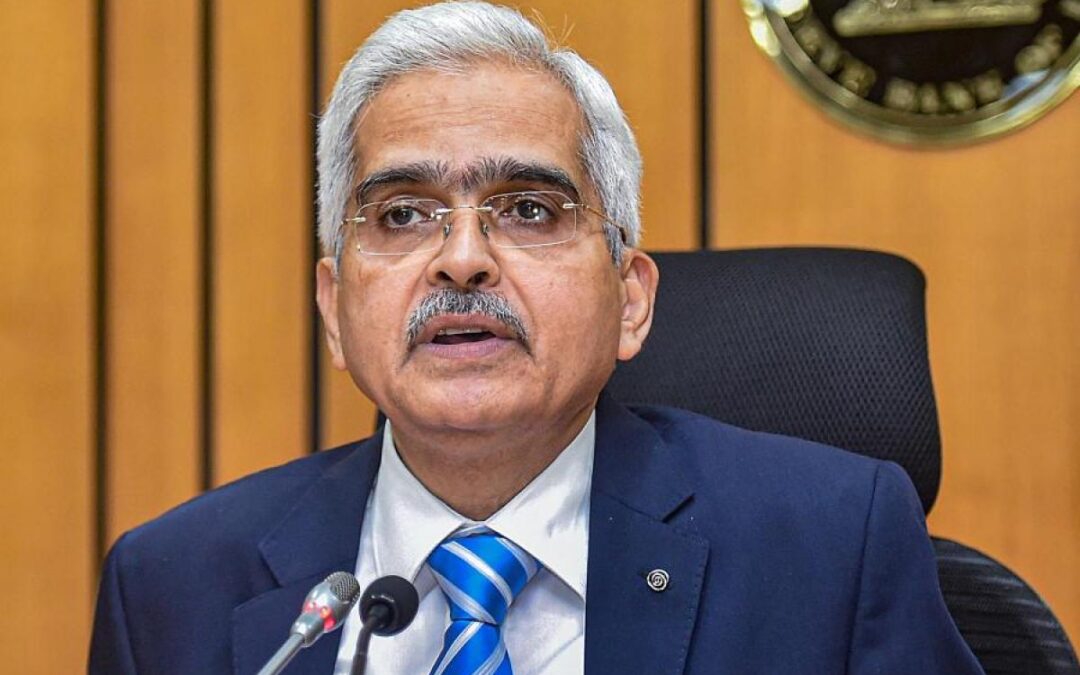
Shaktikanta Das,Governor,RBI
Keeping the approach ” cautious, but proactive”, RBI Governor Shaktikanta Das said that the RBI is emphasizing on three different aspects which will place India in a position that would enable it to deal with the merging crisis and challenges
RBI revised downwards India’s growth projection for the current fiscal (FY2022-23) to 7.2% per cent from its earlier estimate of 7.8 per cent on the back of hardening of prices of commodities and tightening of interest rates globally
It is projecting inflation at 5.7 per cent in 2022-23, with 6.3 per cent in Q1; 5.8 per cent in Q2; 5.4 per cent in Q3; and 5.1 per cent in Q4
Mumbai:
Reserve Bank of India’s (RBI) Monetary Policy Committee on Friday voted to keep the benchmark repo and reverse repo rates unchanged for the 11th consecutive time. “MPC voted unanimously to leave the repo rate unchanged at 4 per cent.
MPC also voted unanimously to keep the stance accommodative,” RBI Governor Shaktikanta Das said in his Monetary Policy Statement.
The repo rate is the interest rate at which the RBI lends short-term funds to banks. The reverse repo rate, the interest rate at which the RBI borrows from banks, remains unchanged at 3.35 per cent.
The RBI revised downwards India’s growth projection for the current fiscal (FY2022-23) to 7.2% per cent from its earlier estimate of 7.8 per cent on the back of hardening of prices of commodities and tightening of interest rates globally.
It is projecting inflation at 5.7 per cent in 2022-23, with 6.3 per cent in Q1; 5.8 per cent in Q2; 5.4 per cent in Q3; and 5.1 per cent in Q4.
The RBI has assumed crude oil prices at $100 per barrel for 2022-23 to arrive at the growth estimation. It also revised its inflation forecast upwards for FY23 to 5.7%.
Taking a view of the supply chain disruptions that have shaken up the global economy, Das said that this is expected to continue in the time ahead.
“Global supply chain disruptions and input cost pressures are expected to linger even longer. Concerns over protracted supply chain disruptions have rattled commodities and financial markets,” the Governor stated.
Notably, the Marginal Standing Facility (MSF) rate and the Bank Rate have remained unchanged at 4.25 per cent, Das informed.
“We are confronted with new but humongous challenges. Shortage in key commodities, fractures in international financial architecture and fear of de-globalisation. Extreme volatility characterises commodity and financial markets,” the RBI Governor said while mentioning that the global economy is witnessing “tectonic shifts” with the commencement of the war in Europe, followed by sanctions and escalating geopolitical tensions.
“While the pandemic quickly morphed from a health crisis to one of life and livelihood, conflict in Europe has the potential to derail the global economy. Caught in the cross-currents of multiple headwinds, our approach needs to be cautious but proactive in mitigating the adverse impact on India’s growth, inflation and financial conditions,” he said.
Keeping the approach ” cautious, but proactive”, Das said that the RBI is emphasizing on three different aspects which will place India in a position that would enable it to deal with the merging crisis and challenges.
The first, as the RBI Governor listed, was a significant improvement in the external sector. “Second, Foreign Exchange Reserves which are at very comfortable levels. Third, substantial strengthening of the financial sector,” Das said.
This is the 11th consecutive policy review when the RBI has decided to maintain a status quo on key policy rates. The central bank has not changed repo and reverse repo rates since May 2020.
Das said the Monetary Policy Committee has also decided to maintain an accommodative policy stance.