
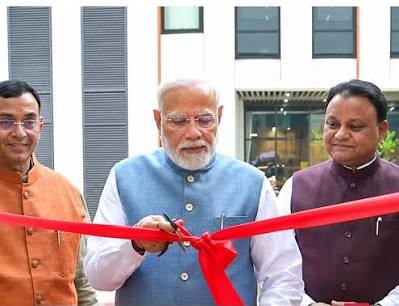
Prime Minister Narendra Modi inaugurating the Reserve Bank of India’s Rs 169-crore data centre and Cybersecurity Training Institute in Bhubaneswar on Sunday
The data centre will host mission-critical payment and settlement systems, along with other flagship initiatives.It will contribute to widening the reach, efficiency and reliability of digital financial services, and will form the secure digital foundation on which India’s increasingly technology-driven financial economy can grow, said a government statement.
Bhubaneswar: Prime Minister Narendra Modi on Sunday inaugurated the Reserve Bank of India’s Rs 169-crore data centre and Cybersecurity Training Institute in Bhubaneswar.
In his address, Modi highlighted the significance of the institutions inaugurated today – the Data Centre and the Cybersecurity Training Institute – in strengthening India’s digital financial infrastructure and advancing its technological self-reliance.
He described the facility as a reflection of India’s changing approach to governance focused on taking the benefits of economic development to every region and every citizen. He emphasised that a secure banking system needs secure digital infrastructure supported by robust data centres and powerful computing systems and RBI’s new data centre is a critical step in this direction.
Citing infrastructure and healthcare expansion, PM Modi said expressways were connecting smaller cities, institutions such as the All India Institute of Medical Sciences (AIIMS) had expanded across several states, and medical colleges were being established in smaller towns. He also cited the establishment of nearly 1.75 lakh Ayushman Arogya Mandirs in villages.
“Today, digital connectivity is expanding into far-flung regions. This is now the genuine purpose of governance: to make citizens’ lives easier and to unlock new opportunities for their dreams,” he said.
Turning to the banking sector, the Prime Minister said financial services had historically remained inaccessible to large sections of society, including poor and middle-class families, small farmers and women.
He referred to the nationalisation of banks in the 1960s and 1970s, saying that despite the stated objective of helping the poor, more than half of the country’s population remained outside the banking ecosystem until 2014.
In her address, Union Minister of Finance and Corporate Affairs Nirmala Sitharaman underscored the strategic importance of resilient infrastructure in safeguarding financial stability and supporting sustained economic growth. She further said that the new Data Centre will house RBI’s mission-critical systems, including RTGS and NEFT, while the Training Institute will build expertise in cybersecurity, AI and other emerging technologies.
Sitharaman said UPI’s annual transaction volume has increased around 13,000 times since 2016-17.
She noted that the platform now processes more than 2,400 crore transactions in a single month, equivalent to nearly 80 crore transactions every day, underscoring the scale and adoption of India’s digital payments infrastructure.
“UPI has become the world’s largest real-time payment system. Its annual transaction volume has grown around 13,000 times since 2016-17, and it now handles over 2,400 crore transactions in a single month, or nearly 80 crore transactions every day,” the finance minister noted.
The finance minister said the rapid growth of UPI has helped foster a vibrant fintech ecosystem that is bringing credit, insurance and investment opportunities to millions of first-time users across the country.
Highlighting the importance of digital infrastructure, Sitharaman described data centres as the “vaults of the digital age” and said the government has taken several measures to boost the sector.
“The vibrant fintech ecosystem built on these initiatives is bringing credit, insurance and investment opportunities to first-time users. A data centre is the vault of the digital age,” FM Sitharaman noted.
Sanjay Malhotra emphasised the Reserve Bank’s commitment to leveraging emerging technologies, strengthening digital infrastructure, enhancing cybersecurity, developing indigenous technological capabilities and supporting the country’s aspiration to become a developed nation by 2047.
The RBI’s facility is spread across 18.55 acres at Info Valley-II in Jatni, and the foundation stone was laid by then RBI governor Shaktikanta Das on March 22, 2023.
It will contribute to widening the reach, efficiency and reliability of digital financial services, and will form the secure digital foundation on which India’s increasingly technology-driven financial economy can grow, it said.
Similarly, the cybersecurity training institute will boost capability building, providing a dedicated institutional platform for cybersecurity and enterprise-technology training, research, and sector-wide capability development, it said.
The site was chosen for its geographical stability, away from seismically active zones and high-risk international border areas, reducing exposure to natural disasters and geopolitical vulnerabilities, an official said.