
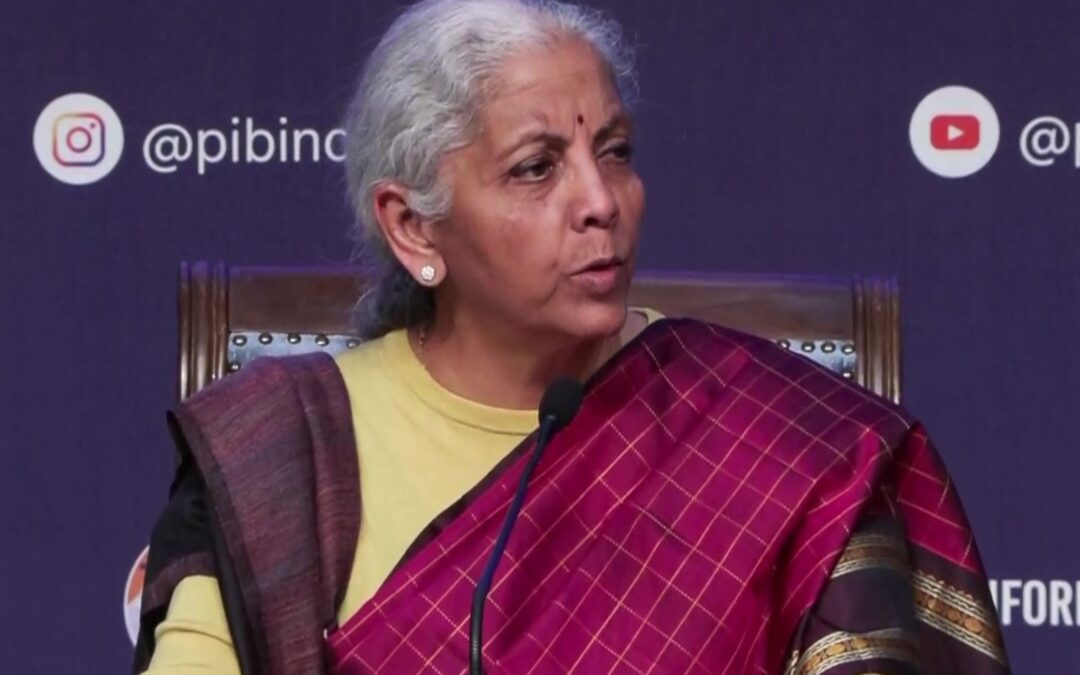
Nirmala Sitharaman, Union Finance Minister
The FSDC discussed reducing cost of intermediation in the financial sector
Union Finance Minister Nirmala Sitharaman also urged the regulators and stakeholders concerned to expedite the process of refund of unclaimed assets (banks deposits, dividends, shares, post office accounts, insurance and pension funds etc.) to their rightful owners
New Delhi: Recent cyber incidents involving the State Bank of India (SBI), the country’s largest bank, have brought the cybersecurity preparedness of India’s financial sector into sharper focus, with the Financial Stability and Development Council (FSDC) reviewing the sector’s cyber resilience and preparedness to protect critical information infrastructure.
At its 30th meeting on Friday, chaired by Union Finance Minister Nirmala Sitharaman, the council took note of the Financial Sector Cyber Security Strategy (FSCSS), formulated by an Inter-Ministerial Group comprising financial sector regulators and cybersecurity agencies, in coordination with the Department of Economic Affairs, Department of Financial Services and the Ministry of Electronics and Information Technology.
The implementation of the strategy is expected to strengthen the overall cyber resilience of India’s financial system amid growing concerns over digital threats to banks and other financial institutions.
The council also discussed the country’s preparedness to protect critical information infrastructure, strengthen existing cyber protection systems and improve cybersecurity readiness among Regional Rural Banks (RRBs).
The discussions underline the importance of coordinated action by financial regulators, banks and cybersecurity agencies to safeguard financial systems, protect customer data and maintain confidence in digital banking.
The discussions also covered India’s preparedness to protect the Critical Information Infrastructure and resilience of protection systems and improving cybersecurity preparedness of Regional Rural Banks (RRBs).
The FSDC, among other issues, deliberated on issues related to macro financial stability and India’s preparedness to deal with them.
Considering the importance of regulatory improvisation and digital modernisation in the financial sector, the FSDC discussed measures towards promoting innovation in the Fintech sector and exploring the prospects of tokenisation of financial assets and other real-world assets.
The FSDC also discussed issues relating to formulating a strategy for implementing the past decisions and the budget announcements, which included:
-strengthening the domestic investment ecosystem and improve resource flow for investment including in the GIFT-IFSC;
-simplification and digitalization of the KYC processes and digital onboarding for NRIs and FPIs;
-reforms to scale up DPIs in India including the Account Aggregator and Unified Lending Interface (ULI) framework with specific focus on MSMEs;
-reducing cost of intermediation in the financial sector, improving the responsiveness of regulations and rationalization of Credit Guarantee Schemes in India.
The FSDC took cognizance of the emerging trends from domestic and global macro-financial situation and stressed upon the need to be vigilant especially in view of the ongoing geopolitical uncertainties, AI boom and steep rise in global bond yields.
The Council recognised the need for proactive efforts to mitigate potential risks to financial stability while adopting adequate safeguards for financial system’s resilience. The members decided to strengthen the inter-regulatory coordination for wider development of the financial sector.
The Union Finance Minister also urged the regulators and stakeholders concerned to expedite the process of refund of unclaimed assets (banks deposits, dividends, shares, post office accounts, insurance and pension funds etc.) to their rightful owners.
The FSDC noted the success undertaken by stakeholders under “Your Money, Your Right” campaign at the district level to refund the existing unclaimed financial assets and guided Ministries and Regulators to pursue additional efforts for timely refund to rightful owners.
The FSDC meeting was also attended by Sanjay Malhotra, Governor, Reserve Bank of India,Anuradha Thakur, secretary, Department of Economic Affairs, Sanjay Lohiya, Secretary, Department of Financial Services, Ministry of Finance; Arvind Shrivastava, secretary, Department of Revenue, S. Krishnan, Secretary, Ministry of Electronics and Information Technology, Pallavi Jain Govil, secretary, Ministry of Corporate Affairs,V. Anantha Nageswaran, chief economic adviser, Ministry of Finance; Tuhin Kanta Pandey, chairperson, Sebi, Ajay Seth, chairperson, IRDAI ,K.Rajaraman, chairperson, International Financial Services Centres Authority, S. Ramann, chairperson, PFRDA, Jayanti Prasad, acting chairperson, Insolvency and Bankruptcy Board of India,Sanjay Bahl, director general, Indian Computer Emergency Response Team (CERT-In); and Aparna Sinha, secretary of the FSDC, Department of Economic Affairs, Ministry of Finance.