
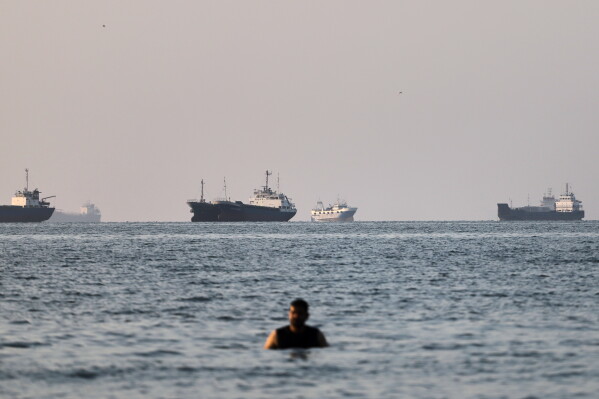
There are growing signs of wariness among vessel operators, with tanker-tracking data compiled by Bloomberg showing more than a dozen supertankers and several Suezmax-class vessels either turning around or reversing course as they approached the key shipping hub of Fujairah in the United Arab Emirates, near the entrance to Hormuz.
Iranian attacks on ships crossing the Strait of Hormuz have surged, potentially threatening the recent recovery in Persian Gulf oil exports.
People working in the shipping industry said there were signs that the flow of cargoes through the waterway may be slowing, after rising close to prewar levels earlier this month. Still, there was no clear evidence of change in oil loadings observed from several of the region’s top producer countries, and one shipowner said movements through Hormuz didn’t appear curtailed.
Hostilities are increasing across the Middle East, with Saudi Arabia coming under a wave of attacks by Yemen’s Houthis, the rebel group with ties to Tehran. The deteriorating situation helped push crude above $106 a barrel in London on Monday, although prices eased a little on Tuesday.
Four tankers were hit by unknown projectiles while transiting the chokepoint in separate incidents on Oct. 11, according to UK Maritime Trade Operations. That’s roughly double the daily average number of attacks observed by the agency in the previous week.
There are growing signs of wariness among vessel operators, with tanker-tracking data compiled by Bloomberg showing more than a dozen supertankers and several Suezmax-class vessels either turning around or reversing course as they approached the key shipping hub of Fujairah in the United Arab Emirates, near the entrance to Hormuz.
Shipbrokers and some owners operating in the region described other signs of a slowdown in traffic, in particular longer waiting times for ship-to-ship transfers. One owner involved in these operations hadn’t experienced a slowdown.
Ship-to-ship transfers, in which shuttle tankers take on the risk of sailing through Hormuz then pump their cargoes onto other vessels for final delivery to buyers, have played a crucial part in boosting exports from the region.
Last week, before the latest escalation, Shell Plc Chief Executive Officer Wael Sawan estimated that oil flows from the Middle East had reached around 80% of pre-conflict volumes. Russell Hardy, chief of trading giant Vitol Group, said on Oct. 6 that 12 million barrels a day of crude and another 2 million of fuels were exiting Hormuz.
Satellite images of export terminals inside the Persian Gulf, which offer a partial picture of what’s happening because they can only be gathered intermittently, didn’t give clear signals of a slowdown.
At Saudi Arabia’s Gulf oil terminals, loading activity has slowed from the surge seen in late September. Eight images from the European Union’s Sentinel 1 and Sentinel 2 orbiters, covering seven days to Oct. 12, show an average of four of the seven loading buoys in use, compared with five or six during the surge.
Five to six tankers were seen loading at Iraq’s southern oil terminal on each of the two days this month for which there were satellite images from Sentinel 2 available. That’s consistent with loading rates observed in the second half of September.
Vessels passing through the waterway have been targeted for much of the Iran war, but with varying degrees of intensity. Previous waves of heavy strikes have led to brief reductions in shipments, though those declines have often been offset by higher volumes in subsequent days.
In July, a spate of attacks by Iran forced a brief lull in the shuttling trade through Hormuz, interrupting the crucial flow to global markets and helping trigger a rally in prices. The chief of Saudi Arabia’s shipping firm told an industry conference on Tuesday that the kingdom remains resolute.
“Right now people know that transportation and vessels and the entire supply chain matters and we’re going to deliver in defiance and in resilience,” Bahri CEO Ahmed Ali Alsubaey said at the WPC Energy Congress.
The event in Riyadh went ahead despite deadly Houthi attacks on the city’s airports, though many executives from international oil firms canceled their attendance.
Bloomberg
.