
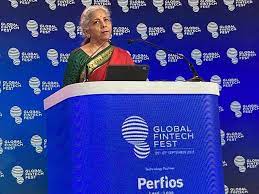
Nirmala Sitharaman,Union Finance Minister
Sitharaman cited the use of technology to speed up harvesting and prepare land for the next crop, as well as drones and aerial geospatial instruments for precision mapping of land parcels that were earlier mapped manually.
Bengaluru: Union Finance Minister Nirmala Sitharaman on Saturday expressed confidence that India could achieve economic growth of more than 10 per cent, stressing the need for greater adoption of technology and innovation, while cautioning against excessive scepticism about the country’s prospects.
Speaking at a fireside chat organised by the IIT Madras Alumni Association here, she said higher economic growth would help accelerate India’s journey towards Atmanirbhar Bharat and Viksit Bharat, but stressed that it would require “a lot more effort” from all sides.
“It is possible to reach 10 plus growth, and I’m not just saying it to pep you all up. It is possible,” Sitharaman said.
She cited the growth of startups since 2015, saying they could make a significant contribution to the economy in the coming years.
Sitharaman emphasised the need to overcome cynicism and “nudge” people to think positively and recognise developments taking place on the ground.
“We have too many naysayers. We have too many people who have vicarious pleasure being derived if India fails. We really cannot afford that. We need to nudge these people to think positive,” she said.
Artificial intelligence, semiconductors and quantum technology are likely to form the next major area of infrastructure investment for India, said Sitharaman while calling for greater investment in AI hardware, training and skills.
Sitharaman said India needs to strengthen its existing digital infrastructure and build greater capacity to support the adoption of AI across sectors.
“So the next large investment in infrastructure would, I think, be AI, semiconductor chips, and building on them quantum,” Sitharaman said.
She said India still needs significant investment in AI hardware and in teachers and institutions that can continuously upgrade their capabilities and provide AI-based knowledge.
Sitharaman also pointed to the need for AI solutions for micro, small and medium enterprises (MSMEs), which operate across a wide range of industries. She said businesses need access not only to technology but also to trainers who can help them use AI to improve productivity and compete with companies in other countries.
“Investment in AI is definitely the next frontier,” she said, adding that the scale and stage of investment would require inputs from academia and industry. She said the focus should now be on determining “at what stage and at what level” India needs to invest rather than debating whether AI should be pursued.
She also said technology and innovation from startups would need to reach more sectors, including agriculture, where she cited the use of drones, precision mapping and technology-enabled market and productivity improvements.
Highlighting the role of technology in agriculture, Sitharaman said technological interventions had made a “spectacular difference” in connecting producers to markets and improving productivity.
She cited the use of technology to speed up harvesting and prepare land for the next crop, as well as drones and aerial geospatial instruments for precision mapping of land parcels that were earlier mapped manually.
“So, with the rapid movement of technology, the innovations which happen in startups will have to get into every sector,” she said.
Sitharaman cited the use of point-of-sale (POS) machines in fertiliser distribution as an example of technology being used to prevent pilferage.
She said the POS system, which was still under pilot testing, recorded details of the farmer, land and crop being cultivated, and provided farmers with information on the quantity of fertiliser that may be sufficient based on soil, irrigation and crop conditions.
The minister said farmers would continue to have a choice in purchasing fertilisers, while the technology would inform them about the quantity that may be sufficient for their crop.
Sitharaman said excessive use of pesticides and fertilisers was contaminating soil and water, and technology could help address the issue.
“So the sooner these technologies reach these sectors, the better it is for India. You will be optimally producing things and therefore adding to the growth,” she added.