
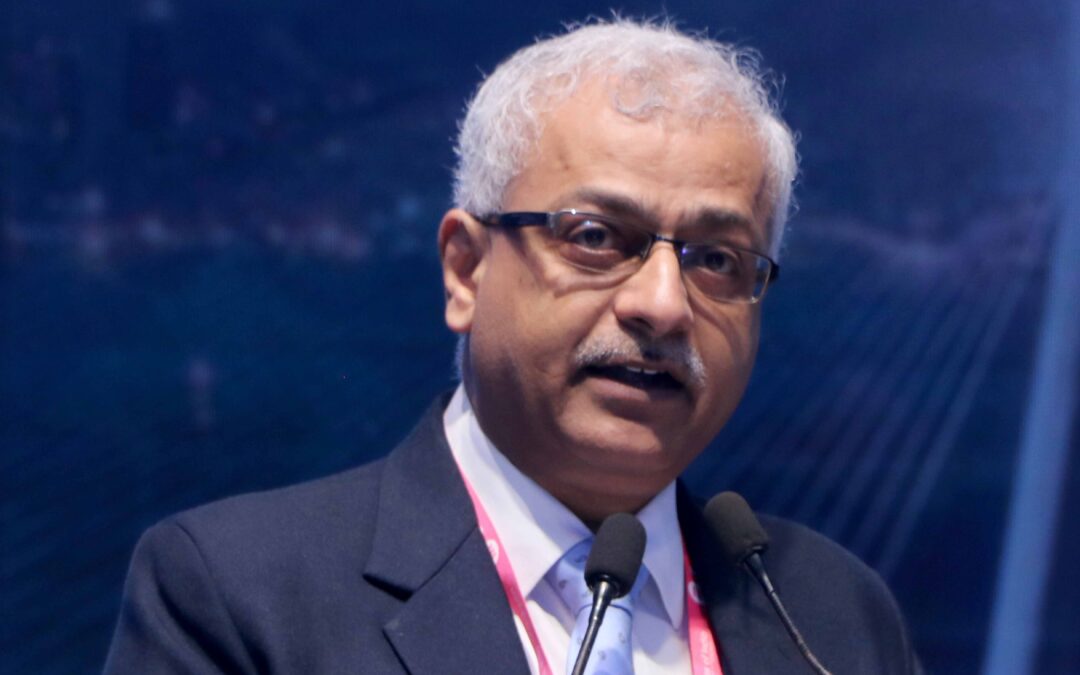
Hitesh Joshi,CMD, GIC Re
Russian President Putin proposed a new insurance mechanism and a collaborative grain market initiative for BRICS nations.
Iranian President Masoud Pezeshkian, called for the creation of a BRICS reinsurance company with initial capital of $10 billion
Hitesh Joshi,CMD, GIC Re, said, “With India holding the BRICS Presidency in 2026, GIC Re chaired meetings of the Task Force on Reinsurance Cooperation during the year. GIC Re has further strived towards strengthening cooperation in reinsurance space during this year. We are hopeful that this co-operation will assist all BRICS countries.”
New Delhi/Mumabi: Even as Russian President Vladimir Putin and Iranian President Masoud Pezeshkian called for the creation of a BRICS reinsurance company, BRICS New Delhi Declaration backed continued discussions on enhancing Group’s reinsurance capacities.
Pezeshkian addressing the BRICS meeting in New Delhi last week, called for the creation of a BRICS reinsurance company with initial capital of $10 billion to reinsure major infrastructure and energy projects and help mobilise private-sector investment while Putin proposed a new insurance mechanism and a collaborative initiative for the grain market among the BRICS nations as he called upon the grouping to adopt a holistic approach in combating pressing global challenges at the concluding session of the 18th BRICS summit.
The New Delhi Declaration welcomed exploration of a BRICS Insurance Resilience Centre (BIRC) as a voluntary shared platform for developing common risk models, exchanging best practices and building specialist capabilities.
The declaration also noted interest among members in taking forward India’s proposal to establish a BRICS Risk Lab at GIFT City’s International Financial Services Centre (IFSC) in Gujarat, with participation open to interested BRICS members.
“We recognise the need for harnessing the collective potential of BRICS to build a more self-reliant BRICS insurance ecosystem to support trade among members, and further discussion on enhancing reinsurance capacities. In this regard, members expressed interest in taking forward the discussions on India’s proposal to host a BRICS Risk Lab, open to participation by interested members, at the GIFT City International Financial Services Centre (IFSC) in Gujarat,” said the BRICS New Declaration.
Hitesh Joshi,CMD, GIC Re, said, “With India holding the BRICS Presidency in 2026, GIC Re chaired meetings of the Task Force on Reinsurance Cooperation during the year. GIC Re has further strived towards strengthening cooperation in reinsurance space during this year. We are hopeful that this co-operation will assist all BRICS countries.”
Putin proposed the new initiatives for economic growth among the BRICS member nations as well as the Global South nations amid crippling sanctions imposed by the Western powers on Moscow for its war on Ukraine.
The G-7 countries, the European Union and the UK prohibited Western companies from insuring any ship transporting Russian crude unless the oil was purchased at or below a specified price cap. The sanctions relating to the insurance sector have adversely impacted Russian crude oil exports.
“We have independent routes for moving capital, labour and technologies. In fact, we can operate regardless of outside pressure,” Putin said.
“We have some promising initiatives going forward, such as creating an insurance mechanism and a grain market. These are Russian proposals, and we invite all other member states to make use of those,” he said without elaborating further.
Putin also complimented the functioning of the New Development Bank (NDB), saying it is handling projects worth USD 140 billion.
The NDB is a multilateral development bank established by the BRICS nations.
“As global challenges keep surfacing, we should adopt a holistic approach to address both the symptoms and root causes,” Putin said.
The proposal, if pursued, could potentially create a new source of capacity for large infrastructure and energy risks across BRICS markets, although its structure, capitalisation and relationship with existing national and international reinsurers would require detailed discussions, said industry experts.
The proposal assumes added significance as BRICS economies confront rising catastrophe, infrastructure, energy and supply-chain risks, while insurance and reinsurance capacity remains uneven across emerging markets.
The BRICS bloc consists of 11 full member countries and 10 partner countries, with a combined nominal GDP of approximately $32.7 trillion and a purchasing power parity (PPP) share of around 40 per cent of global GDP.
The New Delhi Declaration also placed climate and disaster resilience high on the BRICS agenda. Members recognised the growing complexity of disaster risks, particularly those linked to climate change in the Global South, and reaffirmed cooperation on disaster-risk reduction, early-warning systems and risk-informed planning.
BRICS welcomed guidelines for disaster-management early-warning data integration and voluntary principles for climate-resilient urban infrastructure. It also highlighted the need for predictable and accessible financing, including public and private investment, for resilient infrastructure.
The declaration stressed that strengthening infrastructure resilience to climate and disaster risks is critical to sustainable development, with greater emphasis on prevention, anticipatory action and evidence-based risk planning.
“We underscore that strengthening the resilience of infrastructure systems to climate and disaster risks is vital for achieving sustainable development. In this regard, we acknowledge the role of the Coalition for Disaster Resilient Infrastructure (CDRI) as an international partnership for supporting member and partner countries in integrating resilience across infrastructure systems through technical assistance, knowledge exchange, enabling policy and financing approaches, ” highlighted New Delhi Declaration
For the insurance industry, the emerging BRICS agenda could create opportunities for common catastrophe-risk modelling, cross-border reinsurance capacity, climate-risk financing and specialist risk pools, while positioning GIFT City as a potential hub for the bloc’s insurance-risk cooperation, said analysts.
Its full members are Brazil, Russia, India, China, South Africa, Egypt, Ethiopia, Iran, Saudi Arabia, United Arab Emirates and Indonesia while its partner countries are Belarus, Bolivia, Cuba, Kazakhstan, Malaysia, Nigeria, Thailand, Uganda, Uzbekistan and Vietnam.