
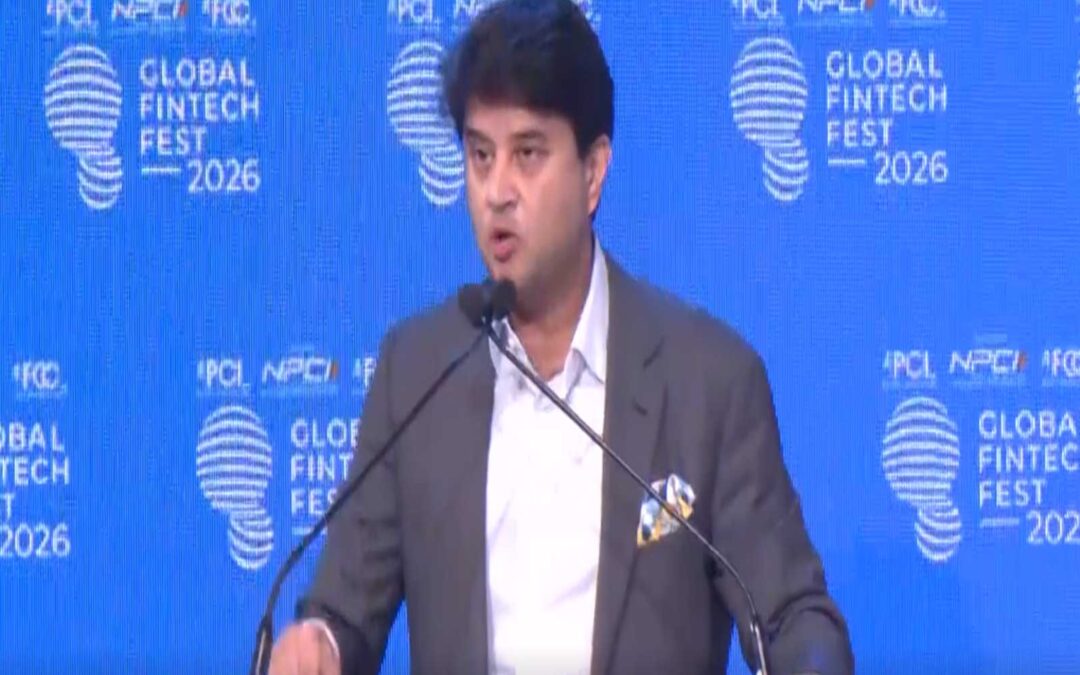
Union Minister for Communications Jyotiraditya Scindia cited the Financial Fraud Risk Indicator (FFRI), mandated by the Reserve Bank of India, as part of efforts to identify suspicious transactions and strengthen coordination across the banking ecosystem.The system connects around 1,500 banks, law-enforcement agencies and other entities, he said, with the aim of moving from detecting fraud after it occurs to anticipating risks before money leaves a customer’s account.
New Delhi: Telecom networks and financial technology must increasingly work together to build a trusted and intelligent digital finance ecosystem, Union Minister for Communications Jyotiraditya Scindia said, underlining the need to connect digital infrastructure, financial platforms and artificial intelligence.
Speaking at the Global Fintech Fest 2026, Scindia said India’s next phase of fintech growth would involve moving beyond connecting people and platforms to connecting intelligence with opportunities.
“The next leap for us in FinTech is from moving from connecting people to platforms to connecting intelligence with opportunity,” Scindia said.
He said the country’s telecom infrastructure has become the foundation for the growth of fintech, with the mobile phone increasingly functioning as a “new bank branch” and mobile networks emerging as gateways to credit and investment.
Scindia highlighted the convergence of 5G, BharatNet, Aadhaar, UPI, fintech and artificial intelligence as key to expanding access to digital financial services.
He said India’s India AI Mission, with a capitalisation of nearly Rs 20,000 crore, 38,000 GPUs, 14 cloud partners and 7,500 datasets, is aimed at building national AI capabilities.
According to the Minister, the combination of AI, telecom networks and financial digital public infrastructure could enable faster credit assessments, personalised financial advice and real-time fraud detection, transforming finance from a reactive system into a more predictive and increasingly autonomous one.
At the same time, he stressed that greater use of technology would require stronger safeguards against financial fraud and compromised digital identities.
Scindia said the government was working towards moving from detecting fraud after it occurs to anticipating and preventing fraudulent transactions before money leaves a customer’s account.
He cited the Financial Fraud Risk Indicator (FFRI), mandated by the Reserve Bank of India, as part of efforts to identify suspicious transactions and strengthen coordination across the banking ecosystem.
The system connects around 1,500 banks, law-enforcement agencies and other entities, he said, with the aim of moving from detecting fraud after it occurs to anticipating risks before money leaves a customer’s account.
The Minister also highlighted India’s progress in digital payments, saying UPI now connects more than 1,000 banks and processes close to 240 billion transactions annually, involving around USD 4 trillion in value.
He said UPI has already expanded to nine countries and India is looking to take the technology to another 20 countries.
Scindia also said India had moved from being primarily a market for technology to becoming a maker of technology, designer of standards and builder of platforms.
Scindia said the broader India digital stack — including Aadhaar, Jan Dhan accounts, affordable smartphones and DigiLocker — had reduced the distance between citizens and financial services.
Aadhaar now has more than 144 crore identities, while 60 crore Jan Dhan accounts have been opened and DigiLocker holds around 9 billion documents, he said.
“From India, serve the world and serve it securely,” he said, stressing that citizens must remain at the centre as technology and finance become increasingly autonomous.
The minister said the eventual goal was to build digital infrastructure that was trusted, inclusive and secure, with citizens remaining at the centre even as technology becomes increasingly autonomous and finance becomes programmable.