
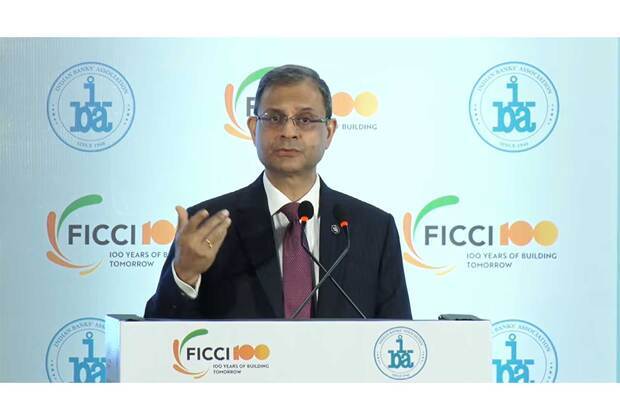
Reserve Bank of India Governor Sanjay Malhotra said AI built on top of this digital infrastructure has the potential to significantly change financial services and improve financial inclusion, but warned that the technology also carries risks if not deployed responsibly.
Mumbai:Artificial intelligence (AI), if deployed carelessly in the financial sector, could create new forms of exclusion and financial instability at a pace that regulators and banks may struggle to manage, Reserve Bank of India Governor Sanjay Malhotra said on Tuesday.
Speaking at the FIBAC 2026 Conference in Mumbai, Malhotra said India has a unique advantage because of its advanced public digital infrastructure, including Aadhaar, UPI, DigiLocker, ONDC, Account Aggregator and ULI.
He said AI built on top of this digital infrastructure has the potential to significantly change financial services and improve financial inclusion, but warned that the technology also carries risks if not deployed responsibly.
“AI, layered on top of this stack, has the potential to do for financial judgment what UPI did for financial transactions: make it instant, granular, and available to the last mile,” Malhotra said.
He added, “AI, deployed well, can close existing gaps in financial inclusion faster than any preceding generation of technology. Deployed carelessly, it can also entrench new forms of exclusion and instability at a pace regulators and banks may struggle to keep up with.”
The RBI Governor said AI is different from previous technological revolutions because it has the ability to multiply intelligence and extend human decision-making to a scale and speed that cannot be matched by a human workforce.
“I will be unambiguous: the Reserve Bank sees AI as a capability to be responsibly harnessed and not merely as a risk to be contained,” he said.
Malhotra said Indian banks cannot afford to remain on the sidelines as AI changes the economics of credit delivery. Traditional lending decisions often depend on financial histories, which may be limited or unavailable for new-to-credit borrowers, gig workers and small businesses without formal books.
AI models can use alternative information such as cash flows, GST filings, utility payments and digital footprints to potentially expand the number of people and businesses considered suitable for formal credit, he said.
He also said AI-enhanced credit risk models, liquidity forecasting and scenario analysis can help banks identify emerging financial stress earlier than traditional financial statements.
The RBI Governor highlighted customer service and financial inclusion as other areas where AI could have a significant impact. AI-assisted systems could help relationship managers serve more customers, while AI-assisted grievance redressal and personalised financial guidance could improve customer services.
For a country as diverse as India, he said, voice-based AI systems in Indian languages could help reduce language barriers in banking. Predictive models could also identify borrowers who are at risk of default early enough for banks to provide counselling rather than simply begin recovery measures.
At the same time, Malhotra said banks need to put strong safeguards in place. The RBI’s approach, based on the recommendations of the FREE-AI Committee and draft guidelines on Model Risk Management, follows a principles-based and proportionate framework.
He said the RBI would continue to engage with the financial industry as AI and its risks evolve, with regulation based on proportionality, consultation, evidence and agility. (ANI)