
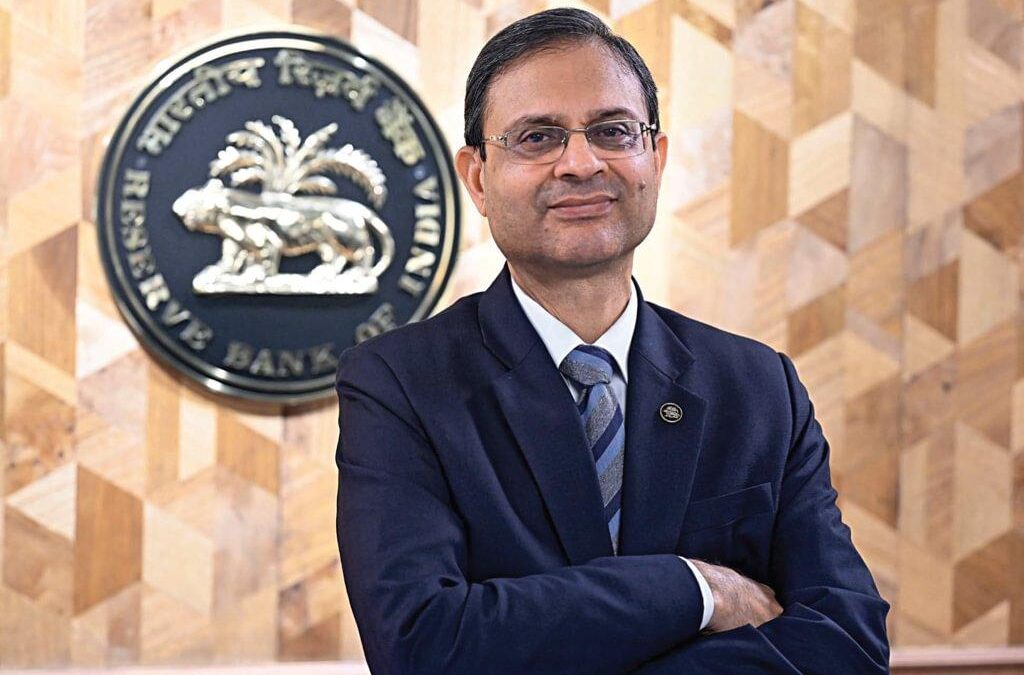
RBI marginally raised the growth forecast to 6.7 per cent while lowering inflation projection to 5 per cent for the current fiscal.
Mumbai: In an expected move, the Reserve Bank of India on Wednesday kept key interest rates unchanged for the third time in a row this financial year as it weighed the impact of uncertain energy prices and supply disruptions caused by the ongoing West Asia crisis.
Announcing the third bi-monthly monetary policy for the current fiscal, RBI Governor Sanjay Malhotra said the Monetary Policy Committee (MPC) has unanimously decided to retain short-term lending rate or repo rate at 5.25 per cent with a neutral stance.
However, RBI marginally raised the growth forecast to 6.7 per cent while lowering inflation projection to 5 per cent for the current fiscal.
The interest rate pause comes even as the Consumer Price Index (CPI) based headline retail inflation has crossed the RBI’s medium-term target of 4 per cent at 4.38 per cent in June.
While manufacturing activity has softened, with the purchasing managers’ index slipping to a five-year low, credit demand remains robust, expanding at nearly 18%.
Domestic demand remains resilient but a weak monsoon, trade and geopolitical uncertainties could emerge as risks to growth, Malhotra said.
Additionally, the rupee has been depreciating continuously since the beginning of this year. The rupee has been hovering between 95 and 96 against the dollar.
The central bank’s six-member rate panel, which includes three external members, voted unanimously to keep rates on hold. The rate-setting panel also retained the policy stance at “neutral”.
An overwhelming majority of 68 out of 72 economists polled by Reuters had forecast that the RBI would stand pat on its benchmark interest rates.
Headline inflation has moved above target mainly because of higher fuel prices, while broader price pressures remain in check, Malhotra said while announcing the policy.
Signalling no rush to act until there is greater clarity on inflation, Malhotra reaffirmed the RBI’s “resolute” commitment to its inflation target.
Shobit Gupta, Chief Investment Officer at Generali Central Life Insurance commented, “As expected, RBI MPC delivered a status quo policy by holding rates steady and continuing the neutral stance while revising inflation expectations lower and at the time increasing growth forecast. It continued to sound cautious on the risks emanating from the Middle East conflict, tighter global financial conditions and El Niño related climatic impacts.Looking ahead, we expect the RBI’s policy decisions to remain firmly data-dependent, with the evolution of macroeconomic conditions shaping the future course of monetary policy.”.
India’s benchmark 10-year bond yield was largely unchanged at 6.78%, while the rupee weakened over 0.1% to 95.09. The benchmark Nifty 50 index was 0.1% higher, while BSE Sensex stayed 0.5% higher.
The RBI’s message was “well balanced, highlighting the risks and, hence, the policy decisions ahead being data-dependent,” said Upasna Bhardwaj, chief economist at Kotak Mahindra Bank.
Bhardwaj continues to see scope for cumulative 50 basis points of hikes in the policy rate between now and March-end.
Churchil Bhatt, senior executive vice president- Investment, Kotak Life Insurance, commented,“While the MPC acknowledged that domestic growth remained resilient and marginally raised its FY27 GDP growth forecast to 6.7 per cent from 6.6 per cent , it remains vigilant of the risks stemming from El Niño and developments in the Middle East.”
On inflation, the MPC drew comfort from the lack of broad-based inflationary pressures and highlighted that the recent uptick is largely on account of supply-side pressures. Full-year CPI projection was marginally revised down to 5.0 per cent from 5.1 per cent , while core inflation was lowered to 4.3 per cent from 4.7 per dent, said Bhatt.
The MPC also emphasized that it will remain proactive in liquidity management and will endeavour to keep overnight market rates aligned with the policy rate corridor. From a market perspective, the 10-year G-Sec yield is expected to remain range-bound, and the yield curve will remain steep, added Bhatt.
BALANCE OF PAYMENTS SURPLUS
India’s external balance of payments is on course to post a “healthy surplus” this year, Malhotra said, adding that capital flow measures announced in June have boosted foreign inflows.
Those steps included a subsidised dollar deposit scheme aimed at the Indian diaspora, alongside incentives for banks and government companies to raise overseas borrowings.
Once considered among Asia’s more stable currencies, the rupee has now become one of the worst-performing emerging market currencies this year, pressured by a mix of expensive oil, capital outflows, widening trade deficits and a surging US dollar.
It has depreciated about 7 per cent so far in 2026 and is down roughly 6 per cent since the outbreak of the Iran conflict in late February.