
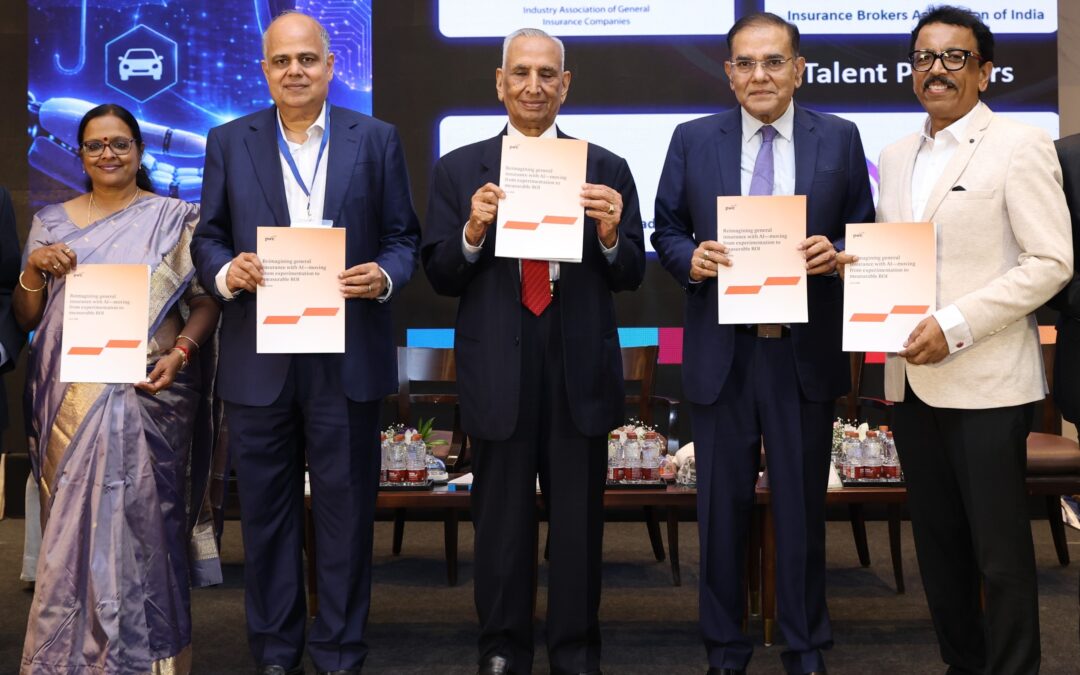
L-R-Girija Subramanian, CMD, New India Assurance, G Srinivasan, MD&CEO, Galaxy Insurance,SK Kanwar of Reliance Industries, BC Patnaik, Director, National Insurance Academy, Amit Roy, Partner and Leader, Insurance & Allied Business, PwC releasing PwC’s new report on “Reimagining General Insurance with AI: Moving from Experimentation to Measurable ROI,” at the India Insurance Summit in Mumbai
“In a country where property and casualty (P&C) insurance penetration remains below one per cent, AI alone cannot be regarded as the solution. The real challenge is whether AI can make insurance more accessible, more transparent and, above all, more trustworthy”Amit Roy, Partner and Leader, Insurance & Allied Businesses, PwC
MUMBAI: As the Indian insurance industry embraces artificial intelligence (AI), the conversation must move beyond experimentation and measuring return on investment (RoI) to a more fundamental question: “ROI for whom?” said Amit Roy, Partner and Leader, Insurance & Allied Businesses, PwC.
PwC released its latest report, “Reimagining General Insurance with AI: Moving from Experimentation to Measurable ROI,“ at the India Insurance Summit organised by Asia Insurance Post under the aegis of New India Assurance, with PwC as the knowledge partner.
The summit brought together senior policymakers, insurance executives, reinsurers, brokers, actuaries, academics and technology experts to deliberate on the theme, “AI and Insurance: Transforming India’s Risk Landscape.”
Speaking at the summit, Roy said that in a country where property and casualty (P&C) insurance penetration remains below one per cent, AI alone cannot be regarded as the solution. The real challenge, he stressed, is whether AI can make insurance more accessible, more transparent and, above all, more trustworthy.
According to Roy, the Indian insurance industry continues to suffer from a significant trust deficit.
“Policymakers, regulators and consumers often perceive insurance as an industry where distributors and companies earn substantial profits. Distributors, on the other hand, argue that margins are under pressure, while insurers continue to grapple with underwriting losses. Despite years of market growth, India’s non-life insurance sector has yet to consistently achieve underwriting profitability, with loss ratios frequently exceeding 100 per cent,” he said.
Drawing a comparison with the United States, where more than 6,000 insurers operate, Roy informed that despite one of the most challenging years marked by devastating wildfires and climate-related catastrophes, the US insurance industry still recorded one of its most profitable years, with the average industry loss ratio remaining below 92 per cent.
“That suggests there are structural efficiencies that India has yet to build. If AI can help address those gaps, it will benefit the entire insurance ecosystem,” he said.
Roy argued that the industry’s focus should not be confined to what AI can do for insurers, but rather what it can do for consumers.
“Customers are not concerned about artificial intelligence, advanced analytics or frontier technologies. They simply want confidence that when they buy insurance, their family, home, vehicle or business will be protected and claims will be settled quickly and fairly when adversity strikes. Today, many consumers remain sceptical even after purchasing insurance. Bridging that trust gap should be AI’s greatest contribution to the sector,” he said.
He observed that insurance remains an industry that often struggles to earn public trust and affection.
“Convincing people that insurance serves a vital social purpose should not be so difficult. Policymakers, regulators, insurers and distributors all have a role in rebuilding confidence,” Roy said.
“The real elephant in the room is trust. If artificial intelligence can help the industry confront and eliminate that trust deficit, it will have delivered its greatest value,” he added.
A copy of the PwC’s latest report can be availed here-Reimagining general insurance with AI—moving from experimentation to measurable ROI