
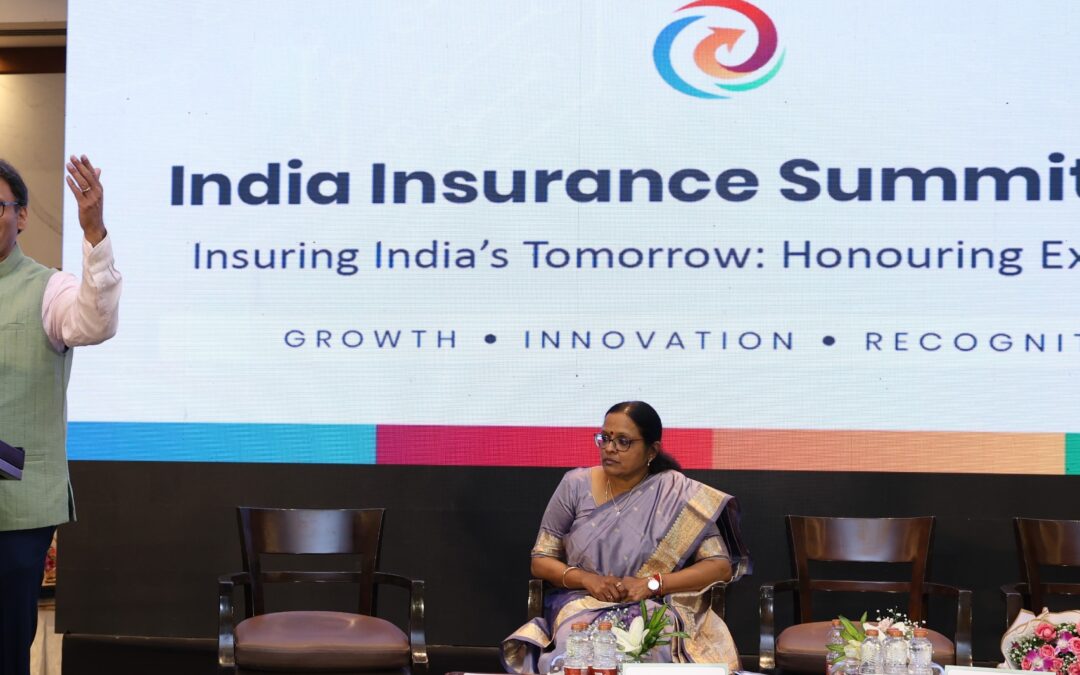
Dr. Debasish Prusty, Additional Secretary, Department of Financial Services is addressing the India Insurance Summit 2026 in Mumbai on Friday. Girija Subramanian, Chairman and Managing Director, New India Assurance is seen on the dias.
The India Insurance Summit 2026, organised by Asia Insurance Post under the aegis of New India Assurance with PwC as knowledge partner, brought together senior policymakers, insurance executives, reinsurers, brokers, actuaries, academics and technology experts to discuss the theme, ‘AI and Insurance: Transforming India’s Risk Landscape.’
Mumbai: Artificial Intelligence (AI) is set to fundamentally transform India’s insurance sector from a business that merely pays claims into one that predicts risks, prevents losses and builds national resilience, a senior Finance Ministry official said, outlining the government’s vision for technology-led financial inclusion and insurance penetration.
Speaking at the India Insurance Summit 2026 in Mumbai, Dr. Debasish Prusty, Additional Secretary, Department of Financial Services, Ministry of Finance, said AI would become a cornerstone of India’s risk management architecture as the country navigates rapid urbanisation, climate change, digitalisation and infrastructure expansion.
“Insurance can no longer remain merely a mechanism for compensating losses after they occur,” Prusty said. “It must increasingly become an instrument for anticipating risks, preventing disruptions, improving resilience and enabling faster recovery for households, businesses and public institutions.”
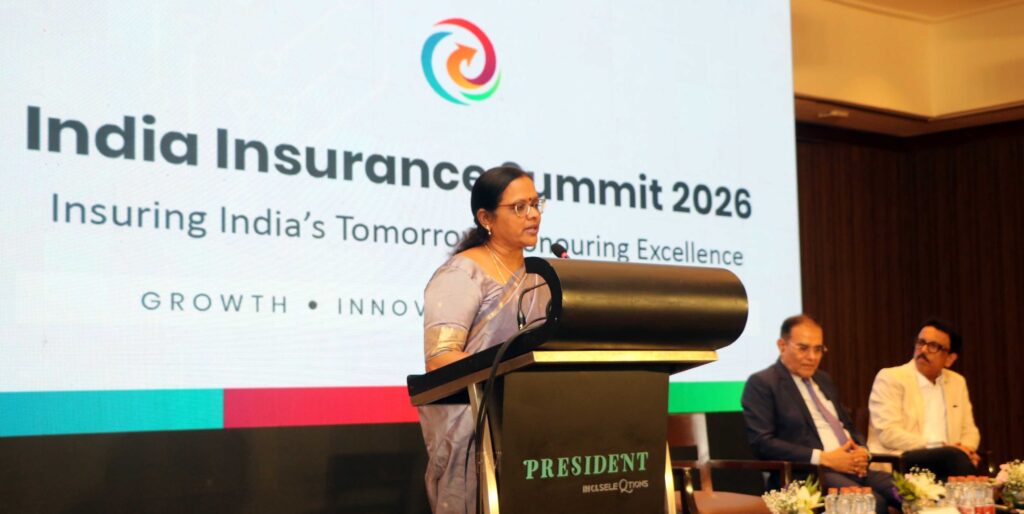
L to R- Girija Subramanian, CMD, New India Assurance is addressing the India Insurance Summit 2026. BC Patnaik, Director, National Insurance Academy and Amit Roy, Partner and Leader,Insurance & Allied Businesses, PwC are seen on the dias.
The summit, organised by Asia Insurance Post under the aegis of New India Assurance with PwC as knowledge partner, brought together senior policymakers, insurance executives, reinsurers, brokers, actuaries, academics and technology experts to discuss the theme, ‘AI and Insurance: Transforming India’s Risk Landscape.’
Prusty’s remarks come as insurers worldwide accelerate investments in AI to improve underwriting accuracy, combat fraud, automate claims processing and develop innovative insurance products amid mounting climate, cyber and operational risks.
He said the government’s India AI Mission seeks to create a comprehensive ecosystem encompassing computing infrastructure, skilled manpower, innovation and responsible AI governance to support the country’s broader vision of Insurance for All by 2047.
According to Prusty, AI-powered underwriting models are already enabling insurers to analyse vast volumes of customer behaviour, telematics, IoT sensor data, satellite imagery and historical claims information to produce more accurate pricing, stronger risk selection and better portfolio management.
He said AI is also facilitating the emergence of innovative products such as usage-based motor insurance, where premiums are linked to driving behaviour, and parametric insurance, which automatically triggers payouts based on predefined events such as floods, cyclones, heatwaves or flight delays.
However, Prusty warned that technological advancement must not come at the expense of consumer confidence.
“The real promise of AI is not automation for its own sake. It is better judgement, better service and better protection,” he said.
“If technology merely reduces operating costs but leaves customers confused, excluded or unfairly treated, we would have missed the larger objective.”
He stressed that the success of AI should not be measured by the speed of decision-making but by whether decisions are fair, transparent, explainable and reliable from the customer’s perspective.
The Finance Ministry official identified claims management as one of the areas where AI could have the greatest impact. AI-driven catastrophe models using satellite imagery can significantly reduce claims assessment time following natural disasters, while parametric insurance products enable almost immediate settlement once predefined trigger conditions are met.
He also highlighted AI’s growing role in detecting fraudulent claims, an area that continues to cost insurers billions globally.
Addressing the summit, Girija Subramanian, Chairman and Managing Director of New India Assurance, said India’s ambition to become a developed economy would require building resilience alongside economic growth.
“The vision of Insurance for All by 2047 is not merely an industry aspiration; it is a national imperative,” she said.
Subramanian noted that insurers today face increasingly interconnected risks arising from climate change, cyber threats, urbanisation and global supply chain disruptions, making traditional underwriting approaches insufficient.
“The question is no longer whether risks will evolve. They already are,” she said. “The challenge is whether the insurance industry can evolve with sufficient speed, depth and responsibility.”
AI, she said, offers insurers an unprecedented opportunity to sharpen underwriting, identify emerging risks earlier, detect fraud faster, improve customer engagement and accelerate claims settlement.
More importantly, predictive analytics can help insurers move beyond post-loss compensation towards proactive risk prevention and mitigation.
Yet she cautioned that human judgement must remain central to insurance decision-making.
“A claim cannot become impersonal simply because it has been digitally processed. Customers must always have access to appropriate human review, escalation and accountability where material underwriting or claims decisions are involved.”
She also called for a robust governance framework covering AI models used across underwriting, pricing, claims, reserving, fraud detection, reinsurance and customer servicing.
Such models, she said, should be properly documented, independently validated and continuously monitored to minimise model risk, eliminate algorithmic bias, strengthen cybersecurity and safeguard customer data.
“The future of insurance will be determined not only by how intelligently we deploy AI, but by how responsibly we govern it,” she said.
“The insurers that will succeed are those capable of combining technology, trust and talent.”
She highlighted the need for greater investments in AI-driven digital infrastructure to help insurers achieve higher standards of scale, service quality, simplicity, speed and trust.
Stressing responsible adoption of technology, she said AI must enhance accountability, operational excellence and accessibility, particularly in expanding insurance penetration across rural India.
B.C. Patnaik, Director,National Insurance Academy, in his key note address said India’s insurance industry remains one of the fastest-growing globally and is expected to sustain double-digit growth for several years, supported by strong economic fundamentals.
With insurance penetration now contributing about four per cent of GDP, Patnaik said India possesses a favourable ecosystem for AI adoption through collaboration among insurers, academic institutions, technology firms, consulting organisations and industry bodies.
Patnaik a former IRDAI member, described AI as “an idea whose time has come,” borrowing from French writer Victor Hugo.
Patnaik said India’s growing digital economy, vast data resources and expanding computing capabilities provide an ideal foundation for large-scale AI adoption in insurance.
While AI has already demonstrated its ability to improve operational efficiency, productivity and profitability, he cautioned that successful implementation would depend on addressing challenges around human oversight, skills development and trust.
“The deployment of AI requires two ingredients—data and computing power. India has both,” he said, urging insurers to invest in workforce skilling so AI complements human expertise rather than replaces it.
He concluded by observing that while AI’s full impact remains uncertain, its transformative potential for the insurance industry is undeniable, much like the internet in its early years.
“Today we are standing on the shore of AI. Nobody can say for sure how it will evolve, but its influence will be profound,” he said.