
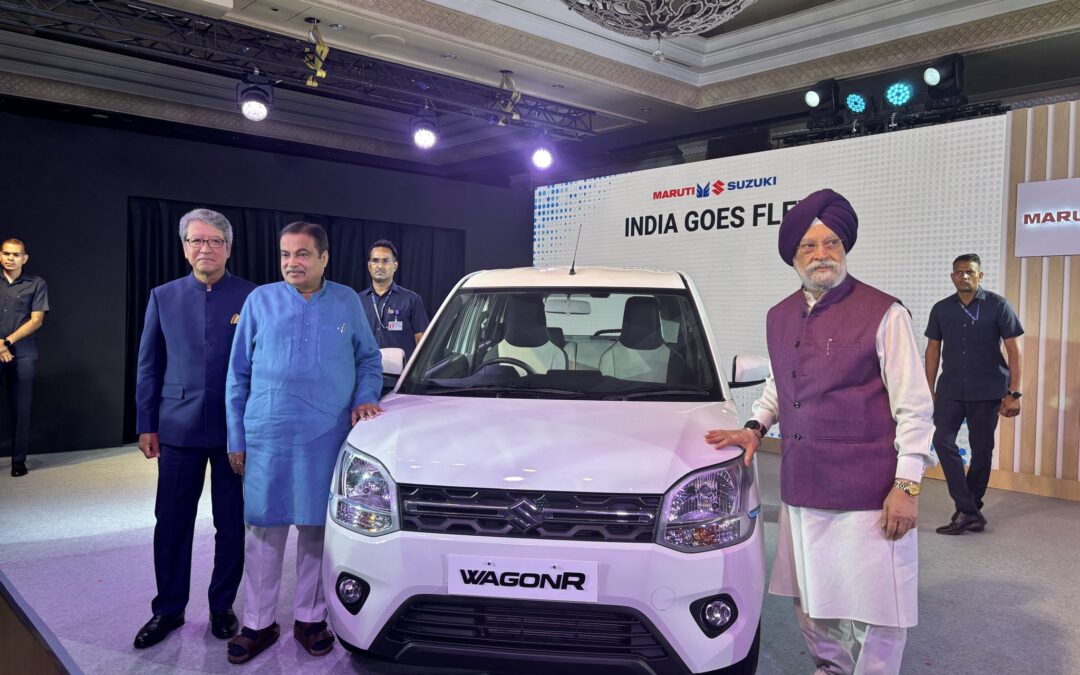
From left, Maruti Suzuki India MD and CEO Hisashi Takeuchi, Union Road Transport and Highways Minister Nitin Gadkari and Union Petroleum and Natural Gas Minister Hardeep Singh Puri during the launch of the company’s first flex fuel car, in New Delhi, Thursday, June 4, 2026.
Maruti Suzuki India Limited Managing Director & CEO Hisashi Takeuchi said, “At Maruti Suzuki, we are committed to offer cars with multiple technologies and fuels.The company is introducing BEVs, Hybrids, CNG/CBG and ethanol flex-fuel vehicles to meet India’s twin goals of reducing oil import and carbon emissions.”
New Delhi:India will start rolling out gasoline blended with 85% ethanol (E85) that will be about 20 rupees per litre cheaper than regular E20 fuel, Oil Minister Hardeep Singh Puri said on Friday.
Indian automakers have started launching flex-fuel vehicles that are compatible with the higher ethanol variant.
E85 fuel will be cheaper than E20 due to its lower calorific value, Puri said. E20 sells for about 102 rupees ($1.07) per litre in New Delhi.
India plans to roll out E85 at 50 to 100 fuel stations in 2026, scaling up to around 5,000 outlets by 2027, he added.
E85 fuel is intended for flex-fuel vehicles, which can operate on gasoline blended with high amounts of ethanol.
Puri said automakers and automobile industry associations are on board for the launch.
Automakers such as Maruti Suzuki and Hero MotoCorp have rolled out flex-fuel compatible variants of their popular WagonR and Splendor models.
E85 fuel will help cut pollution and reduce the country’s reliance on imported oil, Puri said.
India, the world’s third-largest oil importer and consumer, currently sells gasoline blended with 20% ethanol.
Earlier in April, India proposed allowing higher ethanol blends such as E85 and E100 under vehicle rules.
The move followed its 2025 achievement of 20% ethanol blending and aims to further reduce reliance on fuel imports.
The Indian government faced a backlash from motorists after the nationwide rollout, on fears that it may affect the performance of vehicles.
Separately, India’s oil secretary Neeraj Mittal on Friday said the government is working on a programme to boost compressed biogas production.
Meanwhile, Maruti Suzuki India on Thursday launched India’s first flex-fuel car, Wagon R, engineered specifically for ethanol-blended fuel compatibility.
A flex-fuel car gives the flexibility to customers to run on any blend of ethanol and petrol from E20 to E100.
The car comes with advanced ECU calibration capable of adapting to any ethanol blend between E20 (20 per cent ethanol-blended petrol) to E100 (which would allow vehicles to run on nearly pure ethanol).
Maruti Suzuki in a statement said it is introducing flex-fuel technology in the Wagon R, a favourite brand that has long pioneered alternate fuel vehicles in the country, including CNG and LPG.
With the launch of India’s first flex-fuel car, Maruti Suzuki said it is bringing innovation aligned with national energy security and sustainability goals.
Speaking at the launch event, Road Transport and Hghways minister Nitin Gadkari said India imports a large quantity of crude oil every year, and biofuels like ethanol are an important pathway towards reducing this dependence while strengthening our rural economy.
“Flex-fuel vehicles can create a strong and sustainable demand for ethanol, benefiting our farmers, industry, and the environment together,” Gadkari added.
The minister said he is confident that the initiative will encourage other car manufacturers to launch their flex-fuel models and oil industry to enhance ethanol distribution infrastructure.
Also, speaking at the event, Puri said India’s ethanol journey is unstoppable.
“We have transformed our farmers from ‘annadatas’ to ‘urjadatas’, while strengthening India’s energy security,” Puri said.
The minister said flex-fuel vehicles are a win-win for the nation — reducing crude oil import dependence, saving valuable foreign exchange, lowering emissions, and creating new opportunities for rural prosperity.
Maruti Suzuki India Limited Managing Director & CEO Hisashi Takeuchi said, “At Maruti Suzuki, we are committed to offer cars with multiple technologies and fuels.”
He said the company is introducing BEVs, Hybrids, CNG/CBG and ethanol flex-fuel vehicles to meet India’s twin goals of reducing oil import and carbon emissions.
According to him, the ecosystem for ethanol as a fuel in India is in its early stages.
In addition to a significant reduction in oil imports, flex-fuel vehicles can also help to boost farmer income, he added.