
Flagship schemes such as Ayushman Bharat – Pradhan Mantri Jan Arogya Yojana (PM-JAY) have played a pivotal role in increasing access to affordable healthcare services, particularly for vulnerable populations.Expansion marks a critical step towards universal health coverage and equitable access to quality healthcare services across the country
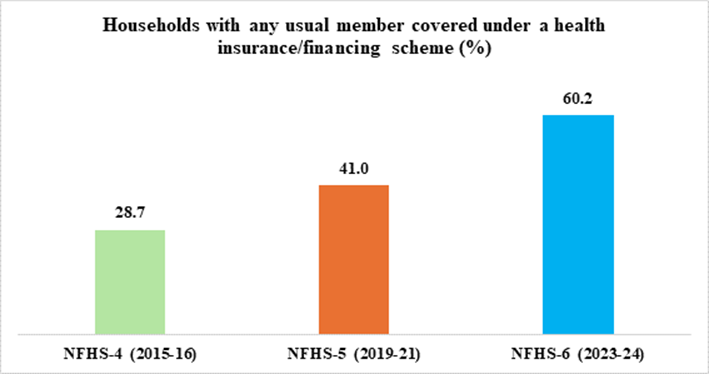
New Delhi:Health insurance/financing scheme coverage in the country has expanded significantly from 41 per cent in 2019-21 to 60.2 per cent in 2023-24 at the household level, reflecting the success of government-led initiatives aimed at strengthening financial protection in healthcare, according to the National Family Health Survey – 6(NFHS-6),prepared by Ministry of Health and Family Welfare(MoHFW).
Flagship schemes such as Ayushman Bharat – Pradhan Mantri Jan Arogya Yojana (PM-JAY) have played a pivotal role in increasing access to affordable healthcare services, particularly for vulnerable populations. This expansion marks a critical step towards universal health coverage and equitable access to quality healthcare services across the country.
The MoHFW released the National Family Health Survey – 6, here today. The NFHS-6 was conducted during 2023-24 by MoHFW with the International Institute for Population Sciences (IIPS), Mumbai as the nodal agency.
According to the report, rural households are leading with 62 per cent health coverage, while urban coverage stands at 56.4 per cent . The report also flags a growing adult health crisis, with 30.7 per cent of women and 27.3 per cent of men now overweight or obese. Obesity is most severe in urban areas, affecting 42.8 per cent of urban women and 36.3 per cent of urban men.
High blood sugar levels are also rising sharply, impacting 17.8 per cent of women and 20.9 per cent of men, largely driven by unhealthy lifestyle habits.
India has witnessed a significant rise in obesity and high blood sugar levels among adults, according to findings from the National Family Health Survey-6 (NFHS-6), pointing to a growing burden of lifestyle-related diseases in the country.
The survey found that 30.7 per cent of women aged 15-49 years were overweight or obese in 2023-24, up from 24 per cent in NFHS-5, which was conducted in 2019-21.
In the same age group, the proportion of men found to be overweight or obese increased from 22.9 per cent to 27.3 per cent.
The findings also showed a substantial rise in elevated blood sugar levels.
Among women aged 15 years and above, the proportion with high or very high blood sugar levels, or those taking medicines to control blood sugar, rose from 13.5 per cent in NFHS-5 to 17.8 per cent in NFHS-6.
Among women aged 15-49 years, the highest prevalence of overweight or obesity was recorded in Puducherry at 46.3 per cent, followed by Chandigarh at 44 per cent, Delhi at 41.4 per cent, Punjab at 40.8 per cent, Tamil Nadu at 40.5 per cent and Andaman and Nicobar Islands at 38.1 per cent.
In comparison, states such as Bihar, Chhattisgarh and Assam recorded comparatively lower obesity prevalence among women.
Among men aged 15-49 years, the Andaman and Nicobar Islands recorded the highest prevalence of overweight or obesity at around 38 per cent, followed by Punjab, Kerala, Tamil Nadu, Delhi and Goa, all of which reported obesity prevalence of more than one-third among men.
For men, the corresponding figure increased from 15.6 per cent to 20.9 per cent.
The rise in obesity coincides with increasing prevalence of elevated blood sugar levels, both of which are major risk factors for non-communicable diseases such as diabetes, cardiovascular ailments and stroke.
Meanwhile, India’s fertility rate appears to be stabilising at 2.0.
Covering nearly 6.79 lakh households across 715 districts, the survey provides vital evidence on population, health, nutrition and family welfare indicators and supports evidence-based planning and programme implementation up to the district level.
Women’s Empowerment and Financial Inclusion
NFHS-6 records continued advancement in women’s digital inclusion and financial empowerment. Women who had ever used the internet nearly doubled from 33.3 per cent to 64.3 per cent.
Women having a bank or savings account that they themselves use increased from 78.6 per cent to 89 per cent, and women having a mobile phone that they themselves use rose from 53.9 per cent to 63.6 per cent.
NFHS-6 provides critical evidence for programme implementation and policymaking across health and social sectors. The findings reflect steady gains in maternal and child health, nutrition, women’s empowerment and access to essential services.
At the same time, emerging challenges such as rising non-communicable diseases, lifestyle-related risks and the dual burden of undernutrition and rising overweight/obesity among adults highlight the need for continued focus on preventive healthcare, behavioural change and balanced nutrition strategies.
Overall, the findings reaffirm India’s steady progress towards achieving the Sustainable Development Goals (SDGs). With continued emphasis on convergence, last-mile delivery and inclusive growth, India is well-positioned to sustain these gains and further improve the health and well-being of its population.