
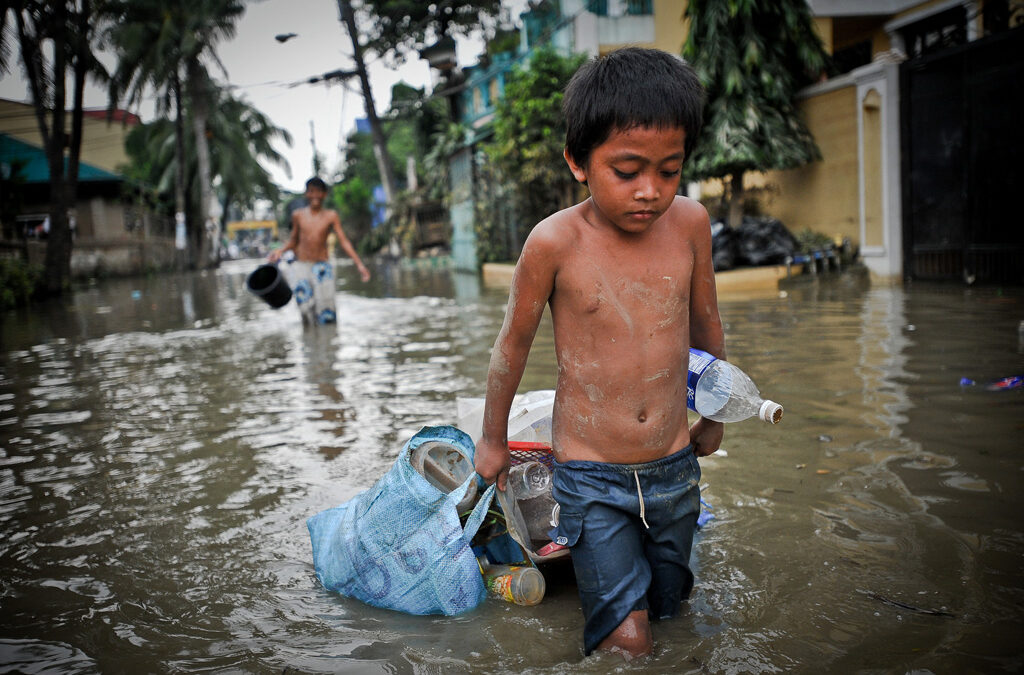
By 2030, Asia will account for around 75% of the global climate adaptation and resilience(CA&R) financing gap, and Asian companies are projected to bear around US$336 billion in annual climate costs.
The Centre for Impact Investing and Practices (CIIP), in partnership with Temasek, Invesco, and ImpactSF (CGIAR Hub for Sustainable Finance), and with support from Dalberg, launched a new report on climate adaptation and resilience (CA&R) in Asia.
This regional study identifies more than 250 priority climate adaptation and resilience solutions for Asia, grounded in the region’s unique climate risks, hazards, and priorities, and informed by analysis of over US$100 billion in climate adaptation and resilience financing flows between 2021 and 2025.
Launching at Ecosperity Week’s Impact Investing Roundtable 2026 on 19th May, the report “Climate Adaptation and Resilience in Asia: Pricing Risk, Sizing Opportunities, Financing Solutions” examines the region’s climate risks, financing gaps, and barriers constraining investment in adaptation and resilience solutions. This includes persistent data gaps, limited visibility of investable opportunities, and unclear financing pathways.
Rising climate risks, widening financing gap
As a region, Asia is warming at twice the global average. Since 2000, 3.7 billion people in Asia have been affected by climate-related disasters – more than triple that in the rest of the world. These risks are already translating into significant economic and social costs.
By 2030, Asia will account for around 75% of the global CA&R financing gap, and Asian companies are projected to bear around US$336 billion in annual climate costs.
Despite this, annual CA&R financing flows in Asia remain significantly below current funding needs. More than US$200 billion is required annually across the region, yet current flows stand at only around US$19 billion.
Agriculture is among the sectors most significantly affected by climate change. While the sector contributes 9.8% to SEA’s GDP, average annual production growth of key staple food has remained below 1.3% over the past decade.
Climate stress could reduce crop yields by as much as 41%, with much of the burden and impact of declining production falling on the region’s 100 million smallholder farmers, many of whom live on less than US$2 a day.
“Impacts of climate risks vary according to crop or livestock, where they are and when the risk is going to be experienced. This determines the necessary strategy required for resilience uplift. ImpactSF uses CGIAR produced scientific data along with AI-based approaches to support investment processes in risk identification and mitigation and impact reporting for investees. This is extremely critical because if risks are ignored, they will eventually impact the financial bottom line of businesses in the agriculture and food sector,” said Dr. Godefroy Grosjean, Co-Lead, CGIAR Hub for Sustainable Finance (ImpactSF).
The CA&R solutions for Asia span three tiers of commercial viability. These include 94 low or no commercial viability solutions but which are foundational in terms of building regional resilience, 93 emerging opportunities that are promising but need catalytic capital to scale, and 65 commercially viable solutions that have proven track record across markets. Together, they offer clear entry points across the spectrum of capital to support solutions at different stages of maturity — from early-stage innovation and ecosystem development to scaling proven technologies and infrastructure.
Accompanying the report are:
-A first-of-its-kind fund flow intelligence dashboard mapping public, private and philanthropic capital flows across China, India, and Southeast Asia (SEA) and impact opportunities
-The Climate Adaptation and Resilience in Asia Case Study Library featuring 50 real-world examples of companies, financial institutions and philanthropies advancing CA&R in respective ways.
-A sectoral deep dive, Building a Climate-Adapted and Resilient Agri-Food System in Southeast Asia, focused on agri-food resilience in SEA – a top priority across the region’s National Adaptation Plans
“Climate adaptation and resilience financing in Asia remains constrained by limited data, fragmented approaches, and uncertainty around where capital can be most effective. We hope this report helps to provide greater clarity on the opportunities and roles different stakeholders can play in advancing solutions across the region. As climate risks intensify, stronger coordination between public, private, and philanthropic capital will be essential to accelerate action,” said Dawn Chan, CEO, Centre for Impact Investing and Practices.
Barriers to unlocking capital
Several structural barriers constrain capital deployment into CA&R. These include underdeveloped policy and regulatory environments; limited access to data on local climate, risk, and costs; and mismatches between solutions and the funding available.
Many CA&R solutions are also highly context-specific, making them harder to implement at scale and require longer investment periods. This calls for coordinated action across the spectrum of capital.
“While it’s clear that investing for climate adaption and resilience is still at a nascent stage, the critical work of identifying barriers, assessing commerciality and mapping context-specific investment opportunities is a major step forward that can move investors from exploration to tactical implementation. This analysis helps bring greater transparency to where capital is most needed across Asia, and where investable opportunities may be emerging,” said Mr. Norbert Ling, Head of Fixed Income Portfolio Management, APAC, Invesco
From fragmented responses to coordinated action
Promisingly, funder interest is growing. Among 165 Asia funders surveyed by this study, CA&R ranks as the leading impact theme, with 81 funders (49%) already actively investing and 47 (28%) exploring entry into the space. Collectively, these 165 funders represent over US$1 trillion in Annual Funds Managed (AUM).
Translating interest into capital deployment, however, requires addressing key constraints faced by funders. Pipeline challenges are the top concern for both active or interested funders, as well as inactive funders in this space.
Macro-level challenges and deal structuring are also key issues for active or interested funders, while main barriers for inactive funders include limited mandate to invest in the space, alongside knowledge and capacity gaps. Addressing these requires a comprehensive approach that strengthens business models, de-risks projects, and builds capacity and data systems.
Seven key building blocks
Recognising the multifaceted needs of the sector, this report sets out a roadmap for scaling CA&R finance in Asia through seven key actions. These include-
-Catalysing action
-Embedding climate adaptation as both a value and growth driver
-Strategic capital mobilisation across the spectrum
-Improving decision-making
-Better climate-risk pricing and valuation of resilience
-Impact-linked decision pathways
-Shared data and knowledge infrastructure
-Laying the foundations
-Climate-aligned financial system
-Cross-sector collaboration and delivery for scale