
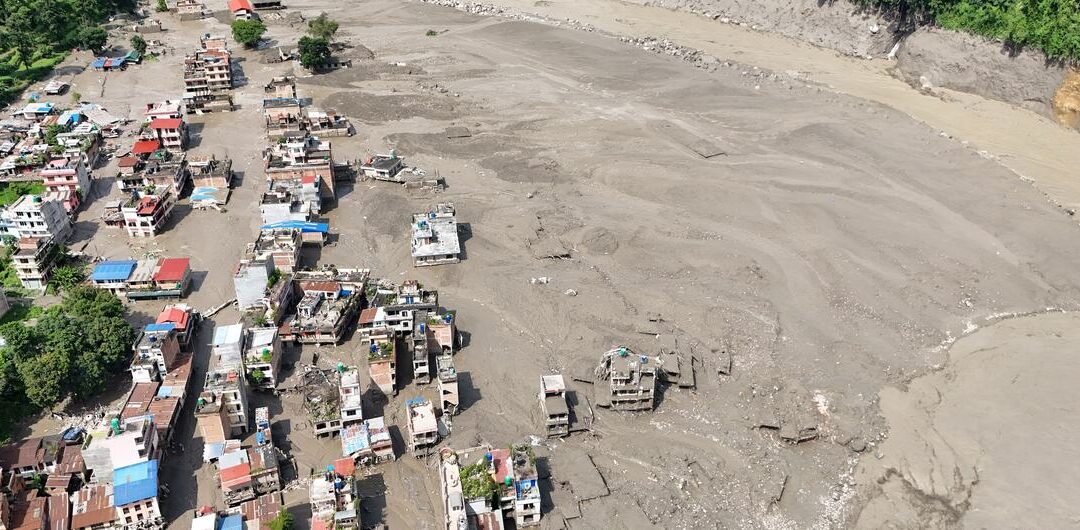
Scientists who’ve studied satellite images said bedrock underneath a glacier high in the Himalayan region had collapsed, taking part of the glacier with it. The rocks and melted water swelled the rivers in the valleys below, causing a torrent of water that swept buildings, bridges and earth downstream.
KATHMANDU: Rescuers worked through mud and debris Friday in areas devastated by a catastrophic flash flood along the Himalayan border between Nepal and China, continuing the search for hundreds of people still missing as the death toll rose and authorities warned that a newly formed, overflowing lake could trigger further flooding.
Nepal police said Friday morning that the country’s death toll had risen to 469 from 390 a day earlier, as rescuers recover more bodies amid the debris. China has not updated its report of just three deaths in Tibet. Together, the two countries have said that more than 1,500 people are missing.
Scientists who’ve studied satellite images said bedrock underneath a glacier high in the Himalayan region had collapsed, taking part of the glacier with it. The rocks and melted water swelled the rivers in the valleys below, causing a torrent of water that swept buildings, bridges and earth downstream.
Nepali and Chinese authorities warned of further flooding from a lake that formed upstream after Wednesday’s disaster and was already overflowing. They urged people in potentially affected areas to move to safer ground.
Fears of a second wave of flash floods loomed large in Nepal after authorities issued a fresh warning on Friday following an increase in the water level of a lake formed by avalanches on the country’s border with Tibet, as the death toll from the flood-related devastation crossed 469.
The National Disaster Risk Reduction and Management Authority (NDRRMA) said the rise in the water level at the site where a devastating flash flood occurred earlier this week raised the risk of another flood in the area.
China’s Ministry of Water Resources on Thursday night sounded an emergency in the Tibet Autonomous Region, cautioning of a threat posed by the barrier lake, which formed near the confluence of Chhochen Khola and Purepu Tsangpo rivers.
These rivers originate in Tibet and flow into Nepal as part of the Bhote Koshi river system.
China’s emergency response system for natural disasters has four levels, with Level-I being the highest and Level IV the lowest.
Rising Water Levels and Downstream Threat
The lake has accumulated an estimated two million cubic metres of water as of Thursday morning, state-run Xinhua news agency reported.
According to forecasts, inflows into the lake could reach about three million cubic metres over the next three days amid continued rainfall, increasing the risk of a breach that could send floodwaters downstream and potentially cause further damage in areas including Gyirong Port at the China-Nepal border and elsewhere downstream.
In response, the ministry has instructed local authorities to closely monitor the barrier lake and rainfall, strengthen forecasting and risk assessments, and accurately identify people living in areas that could be affected downstream, it said.
Advanced Technology Aids Rescue Efforts
China, meanwhile, has deployed satellites and drones to aid the rescue efforts in the flash floods-hit area near the Nepal border in Tibet.
The China National Space Administration (CNSA) said it has deployed satellite resources to conduct emergency imaging of the affected area and retrieve historical imagery.
So far, it has delivered five pre-disaster images and 10 post-disaster images to relevant emergency response and disaster relief departments, providing satellite data support for disaster assessment and mitigation efforts.
China has also deployed its unmanned aerial vehicle (UAV) Wing Loong, equipped with high-definition cameras, to the region for comprehensive reconnaissance of the area, the Xinhua report said.
The Nepal Army said that a team was sent to the border point to inspect the Bhotekoshi River amid the potential of more floods.
The U.S. State Department said 90 Americans were unaccounted for in China and Nepal. It said it was not aware of any U.S. deaths. Three Americans have been rescued.
Nepal’s tourism board has said that among the missing are more than 500 foreigners.
U.S. President Donald Trump said the flooding was terrible to see, describing how “strong, well-built buildings were wiped out like they were toothpicks.”
Speaking to reporters in the Oval Office, Trump said the U.S. spoke with Nepalese leaders and offered to provide “anything they want.”