
Last week, the National Financial Regulatory Administration published draft amendments to the Insurance Law. The first such revisions since 1995 propose tighter oversight of insurers’ shareholders, higher minimal capital thresholds, a wider scope of insurers that can’t be dissolved, early remedies for high-risk firms and better protection for policyholders.
Beijing: China is injecting 300 billion yuan ($45 billion) into its largest banks and insurers, part of the nation’s biggest recapitalization in almost two decades, to shore up the strength of its financial system and sustain lending as economic growth slows.
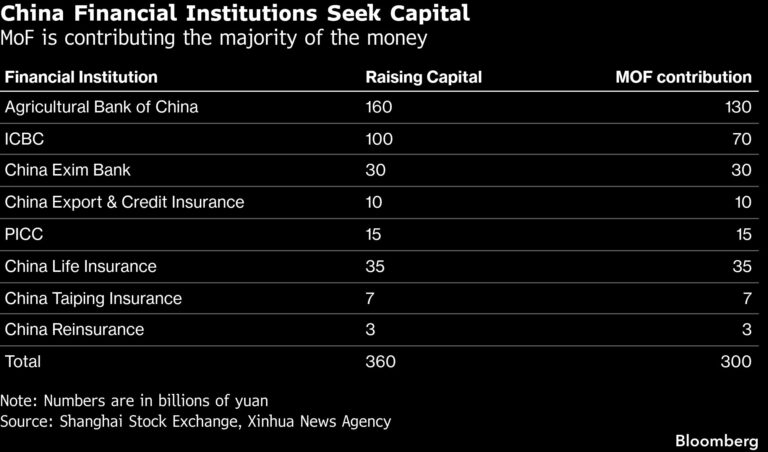
The Ministry of Finance will issue special bonds to recapitalize eight financial institutions, including Industrial & Commercial Bank of China Ltd., Agricultural Bank of China Ltd. and People’s Insurance Company (Group) of China Ltd., according to official announcements on Sunday.
The ministry will fully subscribe to People’s Insurance Company’s 15 billion yuan share placement. It will contribute 30 billion yuan for the Export–Import Bank of China, 35 billion yuan for China Life Insurance, 7 billion yuan for China Taiping Insurance Group, 3 billion yuan for China Reinsurance (Group) Corp. and 10 billion yuan for China Export & Credit Insurance Corp.
China Life Insurance (Group) Co, the country’s largest life insurer, will receive 35 billion yuan ($5.2 billion), while China Taiping Insurance Group will get 7 billion yuan, the two groups said in statements.
Separately People’s Insurance Company (Group) of China (601319.SS), opens new tab said it planned to raise up to 15 billion yuan through a private placement of A-shares to the Ministry of Finance, with the proceeds to be used to replenish its capital.
The initiative could help bolster state insurers that were directed to support the stock market with medium- and long-term funds, while positioning them to help regulators manage smaller, higher-risk insurance companies.
FINANCIAL SECTOR STABILITY
The insurance sector has been grappling with eroding profitability due to persistently low interest rates, with numerous small and mid-sized insurers reporting deteriorating solvency ratios.
China Export and Credit Insurance Corp also said the finance ministry will inject 10 billion yuan to boost its core capital, and China Reinsurance (Group) said it will raise 3 billion yuan.
“The injection is an important step by the country to enhance the financial sector’s ability to serve the real economy and promote the high-quality development of the financial and insurance industries,” China Life said in its statement, adding that it would strengthen the group’s ability to withstand risks.
Taiping said the funds would bolster its solvency and other key indicators.
The package adds to a combined 500 billion yuan of government injection since early 2025 as Beijing steps up its effort to rejuvenate the world’s second-largest economy.
Premier Li Qiang recently urged officials to “strive to achieve” annual growth targets, while policymakers are considering incremental steps such as loan subsidies and other financing support for businesses and consumers.
While China’s financial institutions hold adequate capital buffers, Beijing’s recapitalization plan aims to provide more firepower for lending to businesses and households.
Ensuring financial stability remains a cornerstone of President Xi Jinping’s agenda, particularly as China navigates a protracted trade and technology rivalry with the US. Beijing has aggressively sought to ring-fence risks stemming from a distressed property sector and ballooning local government debt.
“The recapitalization of major state-owned financial institutions has been a policy arrangement for the past two years, rather than an emergency measure,” said Liao Zhiming, an analyst at Huayuan Securities Co. “The key is to make capital arrangements in advance so that the banks have sufficient capacity to meet regulatory requirements and support the real economy.”
The banking sector’s average net interest margin has dropped to historic lows, curbing lenders’ ability to replenish capital through retained earnings. As of June, Chinese banks reported an average capital adequacy ratio of 15.26% and a core tier‑1 ratio of 10.72%.
The recapitalization is the culmination of a policy push that began in 2024, when Beijing first announced plans to replenish its biggest banks. The government work report this year proposed issuing 300 billion yuan of special government bonds for the purpose, underscoring that the latest move has been part of a broader, pre-planned effort to strengthen the financial system.
Last year, Bank of China Ltd. and Postal Savings Bank of China Co. were among four lenders that received a combined $69 billion injection financed through sovereign notes.
Regulators have been gradually replenishing capital at all six of China’s largest state-owned banks, with a key objective of helping them prepare for the second phase of the global Total Loss-Absorbing Capacity, or TLAC, requirements. The lenders, particularly the Big Five, are among the world’s systemically important banks and face additional capital requirements under the framework.
While the banks’ capital adequacy ratios and common equity Tier 1 ratios remain relatively strong, the additional buffers required under TLAC make advance capital planning increasingly important, Liao said. A stronger capital base can also allow the banks to expand lending and absorb potential losses at a time when asset quality remains under pressure, he said.
The recapitalization of insurers reflects a similar precautionary approach. Regulators have previously said they were studying ways to replenish capital at major insurers operating under pressure from a prolonged low-interest-rate environment and the risk of a squeeze between investment returns and the cost of their liabilities.
Last week, the National Financial Regulatory Administration published draft amendments to the Insurance Law. The first such revisions since 1995 propose tighter oversight of insurers’ shareholders, higher minimal capital thresholds, a wider scope of insurers that can’t be dissolved, early remedies for high-risk firms and better protection for policyholders.
Capital injections could strengthen insurers’ solvency positions and improve their ability to withstand investment and underwriting risks, while giving them greater capacity to deploy funds into the economy, said Liao.
Rather than relying solely on direct government spending or monetary easing, Beijing is using its control over the financial system to strengthen the balance sheets of institutions that channel capital toward businesses, households and other parts of the economy.
That could become increasingly important as banks contend with weak credit demand and declining lending margins. The recapitalization gives lenders more room to support government priorities, including financing for strategic industries, infrastructure and private companies, even as the traditional lending business becomes less profitable.
For Beijing, the strategy offers a way to support economic activity while containing financial risks. Stronger bank and insurer balance sheets can provide a larger buffer against losses stemming from the property downturn, local-government debt and weak household demand, while allowing financial institutions to continue playing a central role in the government’s efforts to stabilize growth.
What Bloomberg Intelligence Says:
“ICBC and AgBank could see about 3.5% and 6.3% annualized EPS dilution from plans to raise 100 billion yuan and 160 billion yuan of core Tier 1 capital through A-share placements.”
Agencies