
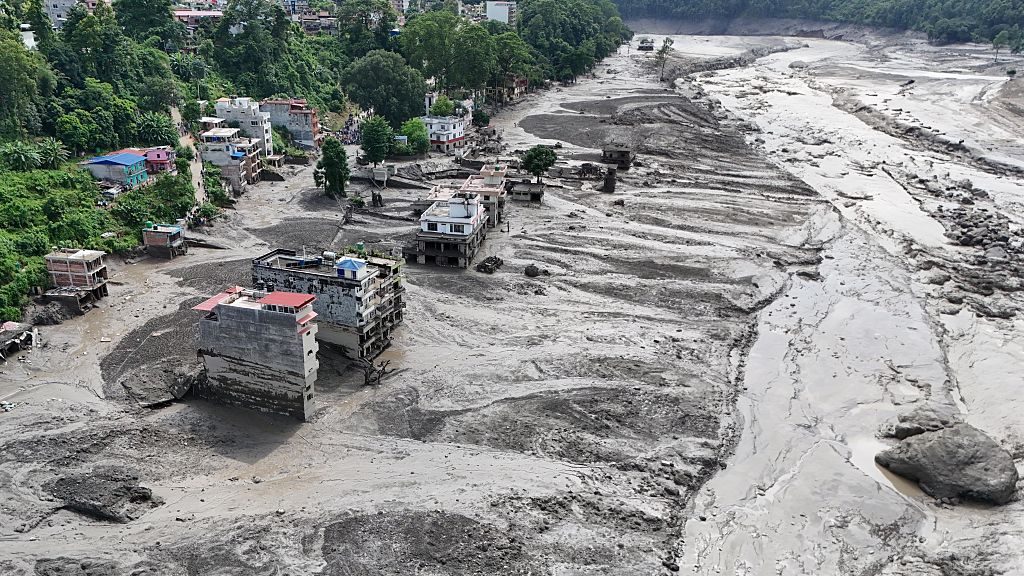
Scientists are examining how a possible glacial collapse and ice-rock avalanche may have triggered the devastating flash floods along Nepal’s Bhotekoshi River, with preliminary assessments indicating that debris may have temporarily blocked the Lhende River and created a landslide dam that subsequently gave way.
Beijing: China on Friday said the collapse of a high-altitude glacier in Nepal may have triggered the massive flash flood disaster that engulfed the Tibet-Nepal border, killing hundreds and causing widespread damage.
The death-toll from the flood-related devastation has crossed 547 as Nepal authorities issued a fresh warning following an increase in the water level in the Bhotekoshi River area.
China on Friday said five people were killed and 558 others, including 260 foreigners, remain missing after flash floods struck a port along the China-Nepal border in Tibet.
Chinese foreign ministry spokesperson Lin Jian, in a media briefing, said, “We noted that experts and official institutions of China and Nepal have made preliminary assessments on the cause of the disaster.”
“According to their analysis, the disaster may have been triggered by the collapse of a high-altitude glacier in Nepal,” he said.
China’s stand underscores that both Beijing and Kathmandu are on the same page about the cause of the disaster, which resulted in massive deaths and widespread damage to settlements, roads, bridges and hydropower infrastructure.
Scientists are examining how a possible glacial collapse and ice-rock avalanche may have triggered the devastating flash floods along Nepal’s Bhotekoshi River, with preliminary assessments indicating that debris may have temporarily blocked the Lhende River and created a landslide dam that subsequently gave way.
The catastrophic flood swept down the Bhotekoshi in Rasuwa district on Wednesday, killing hundreds and destroying bridges and other infrastructure along the river corridor, as it gushed downstream, causing havoc in multiple districts.
Initial speculation after the sudden surge near the Nepal-Tibet border crossing in Rasuwagadhi included a glacial lake outburst flood (GLOF) and an avalanche.
However, scientists analysing satellite imagery now believe a large mass of ice and rock may have fallen into the Lhende River, temporarily blocking its flow and creating a landslide dam that subsequently gave way, The Kathmandu Post newspaper reported.
The National Disaster Risk Reduction and Management Authority has also identified an ice-and-rock avalanche as the leading explanation, according to the report.
A preliminary assessment by Nepalese authorities and a revised analysis by the US Geological Survey (USGS) on Thursday identified a glacial collapse and debris flow as the trigger for the disaster.
The ice-rock avalanche struck the Lhende River, temporarily blocking its flow before the natural barrier gave way and unleashed a massive surge downstream into the Bhotekoshi and Trishuli river system.
About the missing and stranded tourists and pilgrims from India visiting Tibet, Lin said, “The details are being verified. We have already notified relevant countries’ embassies and we will maintain communication with them”.
Chinese officials on Friday said more than 1,000 people, including 555 tourists, have been evacuated from Gyirong County near the Tibet-Nepal border, which was struck by the devastating flash floods, state-run Xinhua news agency reported.
No tourist remains stranded in the area now, according to the state-run Global Times.
President Xi Jinping also sent a message of condolences to Nepalese President Ram Chandra Poudel over the disaster.
Meanwhile, at a meeting of the ruling Communist Party of China presided over by Xi, it was said: “The disaster occurred in a severely cold plateau region with steep valleys, variable weather, many surrounding glaciers and glacial lakes, as well as potential geological hazards, which poses significant challenges to emergency rescue operations”.
The meeting emphasised that all relevant authorities and departments must take resolute and effective measures for the rescue-related work.
Search and rescue plans should be formulated in a scientific manner, and every effort should be made to search for and rescue all missing Chinese and foreign nationals, it stressed.
China will provide emergency aid to the disaster-hit area in Nepal and carry out international rescue cooperation, it added.