
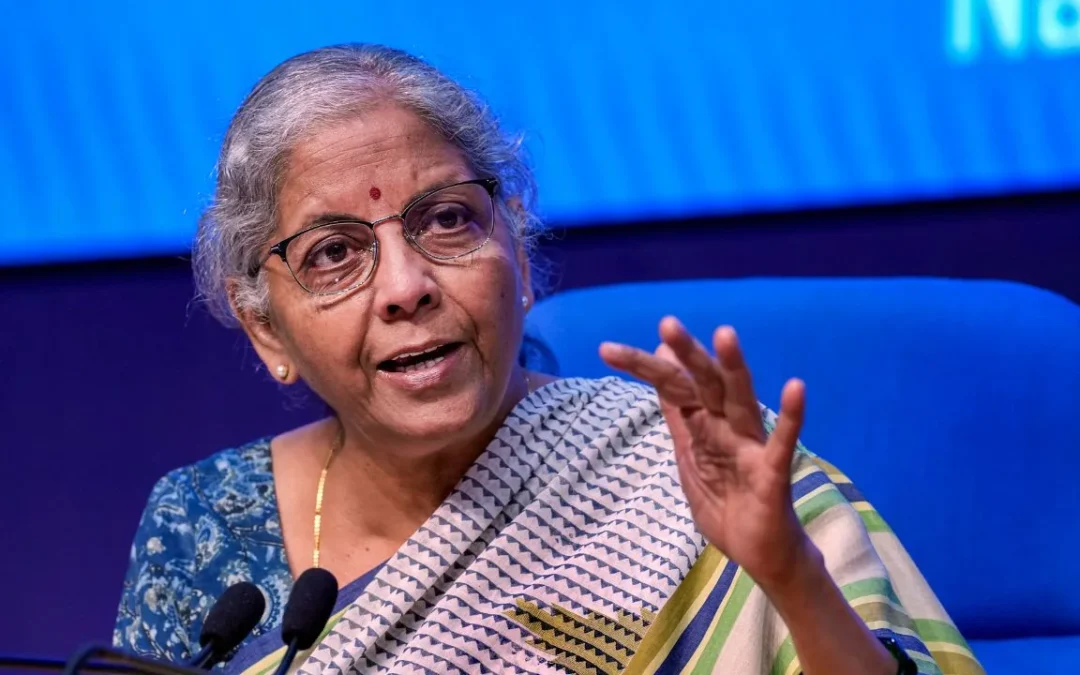
Nirmala Sitharaman,Finance Minister
The government is likely to allow a levy of 0.25 per cent to 0.4 per cent as merchant discount rate (MDR) or charges on UPI payments above Rs 2,000 made to businesses, while keeping payments made by one person to another outside the ambit.
New Delhi:Finance Minister Nirmala Sitharaman on Thursday said the Merchant Discount Rate on digital transactions applies to merchants and not to customers, and the MDR charge would support banks and fintech to invest more on infrastructure and security.
The Taxation and Other Laws (Amendment) Bill, moved by Sitharaman on Tuesday, has sought to remove the bar on banks and payment service providers to levy MDR on notified electronic payment modes.
Govt officials said there is no decision on when the proposal will be implemented.
Hitting out at Congress leader Jairam Ramesh over his remark that ordinary people may have to pay more for using UPI, Sitharaman, in a post on X, said the UPI and Services Steering Committee headed by NPCI is yet to decide on the MDR, which would happen only after Parliament passes the Taxation and Other Laws (Amendment) Bill, 2026.
Through the bill, the government has proposed that the central government can decide, via a notification, which electronic payment modes or transactions would remain free.
The government is likely to allow a levy of 0.25 per cent to 0.4 per cent as merchant discount rate (MDR) or charges on UPI payments above Rs 2,000 made to businesses, while keeping payments made by one person to another outside the ambit.
Meanwhile, amid reports that government may allow Merchant Discount Rate on Unified Payments Interface transactions above Rs 2,000 to businesses, Saurabh Sanyal, Secretary General of ASSOCHAM, has said that it could prove to be a setback for micro, small and medium enterprises as the additional transaction cost may increase their financial burden and discourage digital payments.
“MDR is going to be a setback for smaller businesses because MDR is basically a fee on digital transactions. As of today, the discussions are that it could be around 0.25 to 0.5 per cent on transactions above Rs 2,000. For MSMEs, which undertake a large number of digital transactions, this will become a significant additional cost. It will create turbulence in their digital financial transactions,” Sanyal told ANI on the sidelines of ASSOCHAM’s third FinTech Festival in New Delhi.
It proposes a series of tax changes aimed at boosting investment, supporting manufacturing, providing tax certainty and will replace the Income-tax (Amendment) Ordinance, 2026.
The bill empowers the government to levy MDR on one or more electronic modes of payments, including UPI.
The government may allow levying Merchant Discount Rate (MDR) of 0.25% to 0.4% on UPI transactions above Rs 2,000 made to businesses. The person-to-person (P2P) payments, however, are not likely to be affected.
Sanyal said MSMEs should continue to remain outside the ambit of such charges, while larger businesses undertaking high-value transactions may be in a position to absorb them.
“It should be free for the MSMEs. For the larger businesses, for any transaction beyond Rs 1 crore, one can expect MDR because they are already paying such charges through banking channels and even for overseas transactions. But for the MSMEs, it is not desirable as of today,” he said.
Sanyal said the third edition of ASSOCHAM’s FinTech Festival has attracted more than 1,000 registrations and has brought together policymakers, regulators, fintech companies and industry leaders to deliberate on the future of financial technology in India.
Highlighting India’s rapid digital transformation, Sanyal said the country records around 22 billion digital transactions in a month, making it one of the world’s leading digital payment ecosystems.
“We are the country with the maximum number of digital transactions. This digital transformation is taking place under the guidance and stewardship of Prime Minister Narendra Modi. It is making banking and financial transactions increasingly paperless, allowing people to transfer funds from one place to another instantly with minimum effort,” he said.
Speaking about the fintech industry’s expectations from the government, Sanyal said the sector is seeking a fully paperless and digitally enabled financial ecosystem with minimal dependence on intermediaries.
“The demand for fintech is that we should be 100 per cent digitally recognised. We should do all our transactions paperless and there should be no interference of a third party or a mediator because that stops the leakages which are currently happening,” he said.
He said wider adoption of fintech could also strengthen transparency in financial transactions and help address financial crimes.
However, Sanyal maintained that any measure that leads to increase in cost of digital payments for MSMEs could slow the country’s progress towards a fully digital financial ecosystem.
“Policies like MDR will delay this process of becoming 100 per cent digital. Digital payments should remain affordable for MSMEs, which are among the biggest adopters of digital transactions,” he added.
The Lok Sabha on Thursday passed the ‘Taxation and Other Laws (Amendment) Bill, 2026 ‘, which seeks to amend the Payment and Settlement Systems Act, 2007, Income-tax Act, 2025, and Finance Act, 2026.
The Bill, moved by Finance Minister Nirmala Sitharaman for passing, was approved by voice vote without discussion amid protests by opposition members over their demands related to police action against protestors on July 20.