
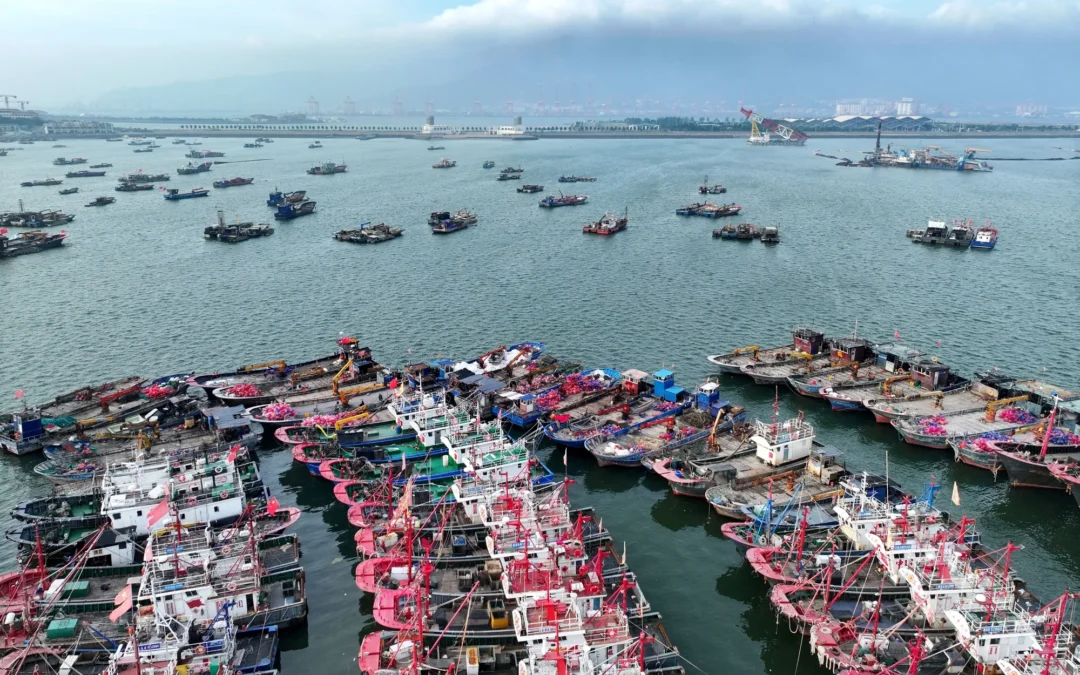
Scientists say climate change is increasingly exposing the world’s second-largest economy to destructive weather events, with this year of particular concern due to the expected emergence of the El Nino weather pattern, which could drive up temperatures and fuel more intense typhoons, as hurricanes are known in the Asia-Pacific region.
Nearly 2 million people were evacuated in eastern China on Saturday as Typhoon Bavi made landfall, bringing strong winds and heavy rain to the region, officials said.
Several Chinese cities, including the capital Beijing, have stepped up emergency response measures as the local authorities issued a red alert for rainstorms as Typhoon Bavi barrelled down on its east coast.
Bavi, the ninth typhoon of the year, landed on the coast of east China’s Zhejiang Province at around 11:20 pm Saturday, Zhejiang provincial meteorological observatory said.
The typhoon, with the maximum wind force at its centre reaching 40 meters per second, churned ashore at Yuhuan City, a county-level city, state-run Xinhua news agency reported.
Earlier on Saturday, China’s National Meteorological Centre issued a red alert for rainstorms, the highest level in its four-tier system, and an orange alert for the typhoon, Xinhua reported.
More than 2 million people have been evacuated in eastern China, the report added.
Widespread Disruptions And Emergency Measures
Within 24 hours until 2 pm on Sunday, torrential rains are expected to drench large parts of the country, including Zhejiang, northern Fujian, northeastern Jiangxi and southern Anhui, and some parts of Beijing and Hebei, according to the national observatory’s forecast.
Scores of flights and ferry services have been cancelled across eastern China, while Zhejiang province has stepped up emergency preparations. Cangnan County, a possible landing point for the typhoon in Zhejiang’s Wenzhou city, has relocated people to safety and set up temporary shelters in local schools.
Beijing Activates Flood Control Response
Nine districts in Beijing activated a Level-I emergency response for flood control on Saturday afternoon after a red alert for torrential rain was issued for these regions.
Downpours are forecast to batter the districts of Fangshan, Pinggu, Miyun, Huairou, Mentougou, Fengtai, Daxing, Tongzhou and Shunyi, mostly in the suburbs, the Beijing Meteorological Observatory announced on Saturday. China Southern Airlines and Spring Airlines have cancelled about 60 flights to and from Shanghai.
The neighbouring province of Zhejiang raised its typhoon emergency preparations to the highest level, which allows it to relocate large numbers of people, close schools and workplaces, and mobilise all resources needed.
Over 50 major tourist attractions in Shanghai have been temporarily closed or adjusted their operating hours on Saturday as Typhoon Bavi barrels toward the country’s eastern coast, according to the Shanghai Municipal Administration of Culture and Tourism and scenic sites operators.
After landfall, Bavi is forecast to move northwestward and then shift toward a more northerly direction.
China’s National Climate Center expects up to six typhoons to form in the Northwest Pacific and South China Sea in July, more than the average of 3.8. Of these storms, up to three could make landfall, above the norm of 1.8. The intensity of the cyclones will also be stronger, it said.
Scientists say climate change is increasingly exposing the world’s second-largest economy to destructive weather events, with this year of particular concern due to the expected emergence of the El Nino weather pattern, which could drive up temperatures and fuel more intense typhoons, as hurricanes are known in the Asia-Pacific region.
Last week, Typhoon Maysak made landfall on China’s southernmost island province of Hainan and quickly swept into the Chinese region of Guangxi, where the storm wreaked the most havoc. The remnants of Maysak also spawned at least two inland tornadoes in central China.
“The problem with these events is that they’re just increasing,” said Benjamin Horton, dean of the School of Energy and Environment at City University of Hong Kong.
The magnitude of the events is increasing and there is no time to recover and become resilient, warned Horton, who expects more frequent and more intense cyclones later this year to drop unprecedented amounts of rainfall, triggering floods, landslides, crop damage and a loss of lives.
“This is just going to repeat and repeat and repeat,” he said.
Water, Water, Everywhere
Towns and villages in Hengzhou, the epicenter of the Guangxi floods, were hit by heavy floodwaters on Monday after dams at local reservoirs failed. At least six people have died in Guangxi, officials said, with 375,000 others affected. The death toll is expected to rise.
“At least a thousand people are stranded in the mountains and it’s dark all around and (we need) urgent rescue,” according to a call for help posted on Chinese social media on Tuesday. Reuters has not independently verified the post.
After the failure of a medium-sized reservoir on Monday, floodwaters carrying large amounts of mud and silt have inundated downstream farmland and villages, national broadcaster CCTV said.
In some houses, floodwaters reached the second floor, trapping villagers on rooftops as violent torrents rushed around them, CCTV reported.
The largely rural city of Hengzhou, home to more than 1 million residents, has six medium-sized reservoirs and nearly 200 smaller ones.
It is also the starting point of a 70-billion-yuan ($10.3 billion) canal project that is scheduled to open in September.
“The severe impacts of Maysak and the looming threat of Super Typhoon Bavi indicate that the 2026 season is more intense and damaging than a typical year,” said Hui Su, chair professor of the Department of Civil and Environmental Engineering at the Hong Kong University of Science and Technology.
“El Nino is shifting typhoon tracks westward toward China’s coast and heightening risks, while climate change makes storms wetter and more destructive.”
Last week, the United Nations weather agency raised its forecast for the rapid emergence of a strong El Nino occurrence in the coming months.
El Nino is a periodic warming of sea surface temperatures in the central and eastern Pacific Ocean, potentially ratcheting up global temperatures and raising the risk of extreme weather, according to the World Meteorological Organization.