
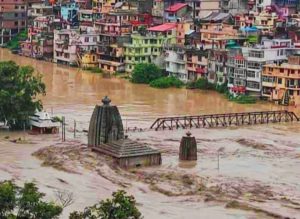
The Western Himalaya was an ecologically fragile region where disasters have significantly increased in recent years.There is a need to move beyond conventional development models by integrating disaster resilience into infrastructure planning, strengthening early warning systems, continuously monitoring vulnerable glacial lakes and developing separate engineering standards for mountain regions, Deepak Rathore,Vice Chairman, State Disaster Management Authority, Himachal
Shimla: Himachal Pradesh would develop disaster resilience infrastructure at an estimated cost of Rs 3,500 crore to strengthen the state’s capacity to withstand natural disasters and minimise future losses, said Chief Minister Sukhvinder Singh Sukhu on Friday.
He was presiding over the valedictory session of a workshop on “Towards Resilience Infrastructure Planning in the Western Himalaya” at Shimla’s Dr Manmohan Singh Himachal Pradesh Institute of Public Administration.
Recalling the devastating disaster of 2023, when around 23,000 houses were damaged and 51 people had died in rain-related incidents, Sukhu said that Himachal Pradesh, being a mountainous state with difficult geographical conditions, has become increasingly vulnerable to natural disasters.
According to a statement issued here, Sukhu asserted that increasing cloudburst incidents in the state were linked to climatic changes and enhanced evaporation from reservoirs created by large dams.
While Himachal Pradesh is currently facing this challenge, he said that other states are also likely to experience similar impacts in the coming years.
The state government, he said, was fully prepared to make decisions in the larger public interest to mitigate the losses.
He said that Himachal Pradesh is endowed with immense natural beauty and tourism remains one of the key pillars of its economy. The government is making sustained efforts to promote tourism while working towards making the state self-reliant.
Sukhu said that the workshop was not merely about infrastructure development, but about shaping a safe, resilient and inclusive future for Himachal Pradesh. He expressed confidence that the deliberations and recommendations emerging from the workshop would contribute significantly to future policy formulation.
He released the report titled “Towards Resilient Himachal Pradesh: Lessons and Recommendations from the 2023 and 2025 Hydro-Meteorological Disasters” on this occasion.
He also launched the Himachal Social Impact Assessment Management System (SIAU Portal), saying that the portal would strengthen data-driven decision-making, improve inter-departmental coordination and enhance administrative efficiency in the state.
Dr Debajit Palit, Centre Head, Centre for Climate Change and Energy Transition, CRF highlighted that climate change in the Himalayas is no longer merely an environmental concern but has equally become a question of development, public investment and long-term economic resilience.
Prabodh Saxena, former Chief Secretary-cum-Chairman, Himachal Pradesh State Electricity Board, traced how the nature of disasters has evolved over time.
According to a statement, he observed that the interaction between climate change and the region’s inherent geological fragility has amplified the scale of socio-economic and infrastructure losses.
Emphasising the imperative of climate-proofing developmental pathways, he remarked, “If we do not prepare today, we are doomed to perish tomorrow.”
Representing the Ministry of Environment, Forest and Climate Change, RK Singh emphasised proper infrastructure planning to avoid future disasters.
Vice Chairman, State Disaster Management Authority, Deepak Rathore, said that the Western Himalaya was an ecologically fragile region where disasters have significantly increased in recent years.
Stressing the need to move beyond conventional development models by integrating disaster resilience into infrastructure planning, strengthening early warning systems, continuously monitoring vulnerable glacial lakes and developing separate engineering standards for mountain regions, he underscored the importance of public awareness in disaster risk reduction.
Chief Secretary K K Pant said that climate change has emerged as a major challenge. He said that the Government’s objective was not merely to reconstruct damaged infrastructure but to build resilient infrastructure capable of withstanding future climate challenges.
He also emphasised the importance of institutional capacity building for effective disaster management.
Former Member of NITI Aayog Dr V K Paul called for a multi-dimensional policy approach involving all stakeholders, saying that disaster resilience cannot be achieved by any single department or institution alone.
Referring to the 2023 disaster as a wake-up call, he said that timely and decisive action was essential to develop resilient infrastructure and minimise future loss of life and property.