
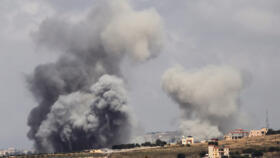
President Donald Trump said he retaliated against the Islamic Republic for shooting down an American Apache helicopter near the Strait of Hormuz. Tehran didn’t confirm shooting down the aircraft and said it was reconsidering whether to persist with negotiations in light of the US attacks.
The US and Iran exchanged strikes overnight, jolting their two-month-old truce and endangering talks aimed at securing lasting peace in the Middle East.
President Donald Trump said he retaliated against the Islamic Republic for shooting down an American Apache helicopter near the Strait of Hormuz. Tehran didn’t confirm shooting down the aircraft and said it was reconsidering whether to persist with negotiations in light of the US attacks.
“The diplomatic process doesn’t happen in a vacuum and to advance any diplomatic process you need a minimum space to be able to move forward,” Esmail Baghaei, a spokesman for Iran’s Foreign Ministry, was cited by the state-run Islamic Republic News Agency as saying. “Wherever necessary, our armed forces will respond to the enemy with authority.”
The US military said it had completed an operation that saw fighter jets strike Iranian air defenses, ground control stations and radar sites near the Strait of Hormuz.
Iran’s Islamic Revolutionary Guard Corps launched missiles on four American targets, including shelters housing F-35 fighter jets and a command center for the US military at Al-Azraq Air Base in Jordan, state-run IRIB News said on Wednesday.
Iran also said it fired drones at the main US naval base in the Middle East, located in Bahrain, and struck Ali Al Salem air base in Kuwait.
Kuwait’s defense ministry said it had intercepted projectiles early Wednesday, while Jordan said it had intercepted five Iranian missiles.
Tehran said it had exercised its “inherent right to legitimate self defense” and warned regional states not to allow the US and Israel to use their territory as a staging post for attacks on the Islamic Republic.
There were no immediate reports of casualties in any of the attacks.
While there have been intermittent indirect talks between Iran and the US about an interim deal — meant to extend the ceasefire by two months and reopen the Hormuz strait — the confrontations underscored how high tensions are running. They followed clashes between Iran and Israel earlier this week, which led to Trump calling on both countries to stop.
Trump has repeatedly said a deal with Iran is within reach and even with the latest flare up, he’s signaled he wants to contain hostilities and avoid a return to all-out war. Pressure is mounting on him to end a conflict that’s killed thousands of people across the Middle East and sent global energy prices soaring.
Oil prices were little changed on Wednesday, with Brent down 0.2% to $91.29 a barrel. That stability suggests markets are broadly confident Tehran and Washington will reach an agreement despite the latest flare-up. Prices, while still up significantly since the war started on Feb. 28, have fallen from highs of around $118 in late April.
The American military described its operations as a “proportional response to recent attacks on US forces and international commercial ships transiting regional waters.”
Both pilots in the Apache helicopter were rescued after their aircraft was struck while patrolling the Strait of Hormuz earlier this week. A US official, who asked not to be named because an inquiry is ongoing, said initial indications show the aircraft crashed after a collision with a Shahed drone and Centcom is assessing whether it was intentional.
Key hurdles in the negotiations include Tehran’s demand that Washington unfreezes more than $10 billion of frozen funds held in foreign countries. It’s also unclear whether Iran will agree to diluting its stocks of highly enriched uranium or sending them to another country such as China.
Lebanon, where Israel is fighting Hezbollah, is another sticking point. Iran fired missiles at Israel days ago after the Jewish state targeted the Iran-backed militia and infrastructure in Beirut, the Lebanese capital. Israel retaliated despite Trump urging Prime Minister Benjamin Netanyahu not to.
On Monday, Iran and Israel agreed to stop attacking each other. Tehran reported that some military personnel were killed in Israel’s attacks, while Israel intercepted incoming missiles.
Iran and the US have been negotiating mainly via Pakistan and states such as Qatar. Pakistani-led intermediaries were continuing discussions with both sides this week, according to people familiar with the matter, who asked not to be identified due to the sensitivity of the subject.
Bloomberg