
Citizens can now lodge grievances by simply speaking, in their own native language; the system automatically identifies the right Ministry and Department
New Delhi:The Centre on Saturday unveiled an Artificial Intelligence (AI)-enabled chatbot to help citizens raise grievances against government departments online.
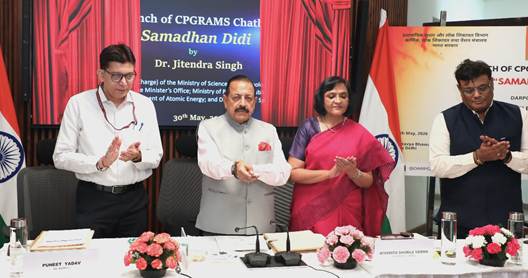
Launching the chatbot named ‘Samadhan Didi’ here, Union Minister of State for Personnel Jitendra Singh termed it as “democratisation of the public grievance mechanism” in the nation showcasing the government’s unwavering commitment to enhance ease of using public services for citizens.
The chatbot marks a significant step towards making public grievance redressal simpler, more accessible and truly multilingual, he said.
A citizen can now lodge a grievance simply by speaking, in their own language, describing the concern in plain words ‘ without needing to know which ministry/department, category or sub-category it belongs to, Singh said.
The chatbot understands the concern, asks a few relevant clarifying questions, automatically identifies the appropriate ministry, department, category and sub-category, and files the grievance with the correct authority, the minister said.
Developed by the Department of Administrative Reforms and Public Grievances (DARPG) in collaboration with Bhashini (an AI powered tool), the chatbot has been developed within secure government infrastructure, ensuring data privacy.
At the launch event, the chatbot was demonstrated live and tested in different Indian languages.
Singh said that a citizen-centric approach has remained at the core of governance reforms under the leadership of Prime Minister Narendra Modi.
Underscoring the transformative role of technology in public administration, the minister said that Artificial Intelligence is driving the democratisation of grievance redressal — making it more accessible, responsive and efficient — and that AI-enabled tools are strengthening citizen engagement and improving the quality and speed of grievance resolution.
Emphasising that these steps are testimony of the government’s ‘whole of the nation’ approach, Singh urged the states and other stakeholders to adopt and integrate AI-driven, voice-assisted tools like “Samadhan Didi” into their own state-level grievance portals to reach out to the last mile.
Highlighting the paradigm shift in the public grievance mechanism in the country in the last 12 years of the Modi government, he said that when the government assumed office in 2014, the grievance redressal system witnessed limited public participation, with only about 2 lakh grievances being registered annually through CPGRAMS portal.
The number of grievances received through the system has now increased manifold to over 25 lakh every year, Singh said.
The Centralised Public Grievance Redress and Monitoring System (CPGRAMS) allows citizens to raise grievances against government departments online.
Singh said that this shift reflects growing public confidence in the government’s responsive and citizen-centric approach when the grievance disposal rate has now crossed 95 per cent.
The minister observed that the chatbot reflects the commitment to governance that reaches the last citizen.
He said that India’s linguistic diversity must be an enabler of access rather than a barrier, embodying the spirit of a self-reliant, technologically sovereign India in which every citizen’s voice is heard, in their own words and in their own language.
Singh said that efforts are underway to expand linguistic accessibility on the CPGRAMS platform.
Beyond the 22 languages of the Eighth Schedule of the Constitution already supported, regional and indigenous languages such as Bhojpuri, Garo, Khasi and Mijo and Bodhi are being incorporated in a phased manner, ensuring greater inclusivity for citizens from diverse linguistic backgrounds.
Singh said that CPGRAMS has emerged as a global role model for citizen-centric governance, exemplifying how technology-enabled governance can enhance transparency, accountability and responsiveness while strengthening trust between citizens and the government.
The system integrates the language capabilities of Bhashini with grievance-classification models trained on CPGRAMS data, enabling a seamless experience across Indian languages, according to a Personnel Ministry statement.
The chatbot understands the concern, asks a few relevant clarifying questions, automatically identifies the appropriate ministry, department, category and sub-category, and files the grievance with the correct authority, the minister said.